

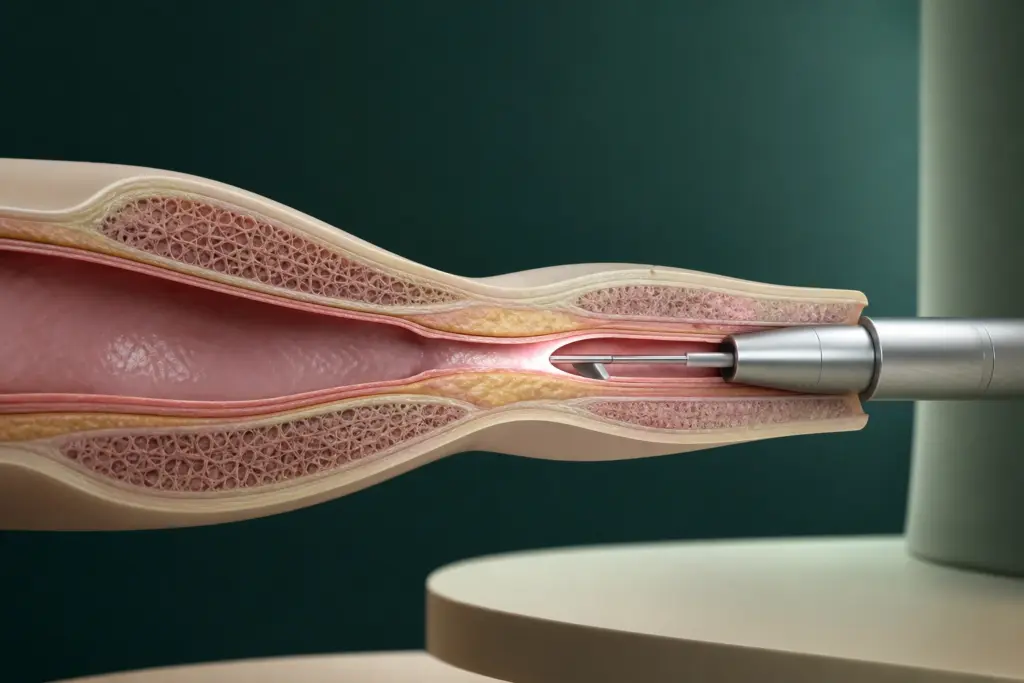
Minimally invasive treatments for urethral stricture
Urethral dilatation and optical internal urethrotomy (OIU) – also known as direct vision internal urethrotomy or DVIU – are minimally invasive treatments used to widen a narrowed urethra caused by scar tissue. A urethral stricture can restrict urine flow and cause symptoms such as a weak stream, difficulty starting urination, straining and incomplete bladder emptying.
Both procedures are performed through the natural urinary passage, without external cuts. Mr Gidon Ellis specialises in endourological procedures and the assessment and treatment of male urinary flow problems, including urethral strictures.
What is a urethral stricture?
A urethral stricture occurs when scar tissue develops within the urethra, causing the urine passage to become narrowed. This can happen following previous instrumentation (such as catheterisation or urinary procedures), trauma, inflammation or infection. In some cases, no clear cause is identified. The narrowing increases resistance to urine flow and may prevent the bladder from emptying normally.
What is urethral dilatation?
Urethral dilatation is a procedure that gently stretches the narrowed area of the urethra using specialised instruments. The aim is to widen the channel and improve urinary flow. The procedure is usually performed under anaesthesia and may be combined with temporary catheter placement to allow the urethra to heal.
What is optical urethrotomy (DVIU)?
Optical urethrotomy, also known as direct vision internal urethrotomy (DVIU), is an endoscopic procedure used to open a urethral stricture. A small telescope is passed through the urethra, allowing the narrowed area to be directly visualised. A fine instrument is then used to carefully divide the scar tissue and widen the passage. The procedure is performed internally, without any external incision.
Why patients choose endoscopic stricture treatment
Urethral dilatation and DVIU offer several advantages:
- No external cuts or scars
- Minimally invasive treatment
- Usually performed as a day-case procedure
- Relatively quick recovery
- Can significantly improve urinary flow in appropriately selected patients
Who is suitable for dilatation or DVIU?
Suitability depends on several factors, including:
- The length of the stricture
- The location within the urethra
- Whether it is a first-time or recurrent stricture
- Previous treatments
- Individual symptoms and preferences
Shorter, simpler strictures are generally more suitable for endoscopic treatment. For longer, recurrent or complex strictures, a reconstructive procedure called urethroplasty may provide a more durable solution. Where urethroplasty is the most appropriate option, Mr Ellis will discuss this and arrange referral to an experienced reconstructive urological surgeon.
Recovery after urethral dilatation or DVIU
Most patients go home on the same day. A urinary catheter is often left temporarily after treatment to allow the urethra to heal. The duration depends on the characteristics of the stricture and the procedure performed.
It is common to experience:
- Mild burning when passing urine
- A small amount of blood in the urine
- Increased urinary frequency or urgency for a short period
These symptoms usually improve as healing takes place. Follow-up assessment helps confirm improvement in urinary flow and monitor for recurrence.
Can a urethral stricture come back after treatment?
Yes. One of the most important aspects of urethral stricture treatment is understanding the possibility of recurrence.
Endoscopic treatments such as dilatation and DVIU can provide excellent symptom relief, particularly for suitable strictures. However, scar tissue can sometimes reform over time.
The likelihood of recurrence depends on factors including:
- The length and location of the stricture
- The underlying cause
- Previous treatments
- Individual healing factors
For some recurrent or complex strictures, urethroplasty may provide a more durable repair.
Clean intermittent self-catheterisation (CISC)
In some patients, clean intermittent self-catheterisation (CISC) may be recommended after treatment of a urethral stricture. This involves the patient gently passing a small catheter through the urethra at planned intervals to help maintain the opening of the treated area.
CISC may be used:
- After urethral dilatation or optical urethrotomy in selected patients
- In patients who are at higher risk of recurrence
- As a strategy to maintain urethral patency where further surgery is not preferred or appropriate
The decision to use CISC is individualised. Not every patient requires this approach, and Mr Ellis will discuss whether it is appropriate based on the characteristics of your stricture, previous treatments and personal circumstances. Patients who use CISC are taught the technique carefully, with advice on hygiene, catheter choice and frequency of use.
How is urethral stricture followed up?
Follow-up after treatment is important because recurrence can sometimes occur before symptoms become severe.
Monitoring may include:
- Discussion of urinary symptoms
- Repeat urine flow testing
- Bladder scans to assess emptying
- Further assessment if symptoms recur
Early review allows recurrent narrowing to be identified and managed before significant bladder problems develop.
Urethral dilatation and DVIU at a glance
| Full name | Urethral dilatation and direct vision internal urethrotomy (DVIU) |
|---|---|
| Treats | Urethral stricture |
| Technique | Endoscopic treatment through the natural urinary passage |
| Anaesthetic | Usually general or spinal anaesthetic |
| Hospital stay | Usually day case |
| Recovery | Usually days to a few weeks |
Frequently asked questions
Is urethral dilatation the same as prostate surgery?
No. These treatments address different problems. Urethral dilatation and DVIU treat narrowing of the urethra caused by scar tissue. Prostate procedures such as HoLEP or TURP treat blockage caused by an enlarged prostate.
Will my urine flow improve after treatment?
Many patients experience a significant improvement in urinary flow after successful treatment. The degree of improvement depends on the severity and cause of the stricture.
Will I need a catheter?
Most patients require a temporary catheter after treatment. The duration depends on the characteristics of the stricture and the procedure performed.
Is optical urethrotomy better than dilatation?
Both approaches aim to widen the narrowed urethra. The best option depends on the individual stricture characteristics and previous treatment history.
What happens if the stricture keeps returning?
If a stricture repeatedly recurs, further assessment is needed. Some patients may benefit from alternative approaches, including urethroplasty.
Why choose Mr Ellis?
Urethral strictures require careful assessment because symptoms can overlap with other causes of poor urinary flow, including enlarged prostate and bladder dysfunction. Mr Ellis uses his endourological expertise to provide minimally invasive treatment where appropriate, while recognising when more complex reconstructive approaches may be required.
Treatment recommendations are personalised, with clear discussion of the benefits, limitations and likelihood of recurrence for each option.
Arrange a consultation
If you have a weak urinary stream, difficulty emptying your bladder or have been diagnosed with a urethral stricture, Mr Gidon Ellis can provide specialist assessment and discuss the most appropriate treatment options.