

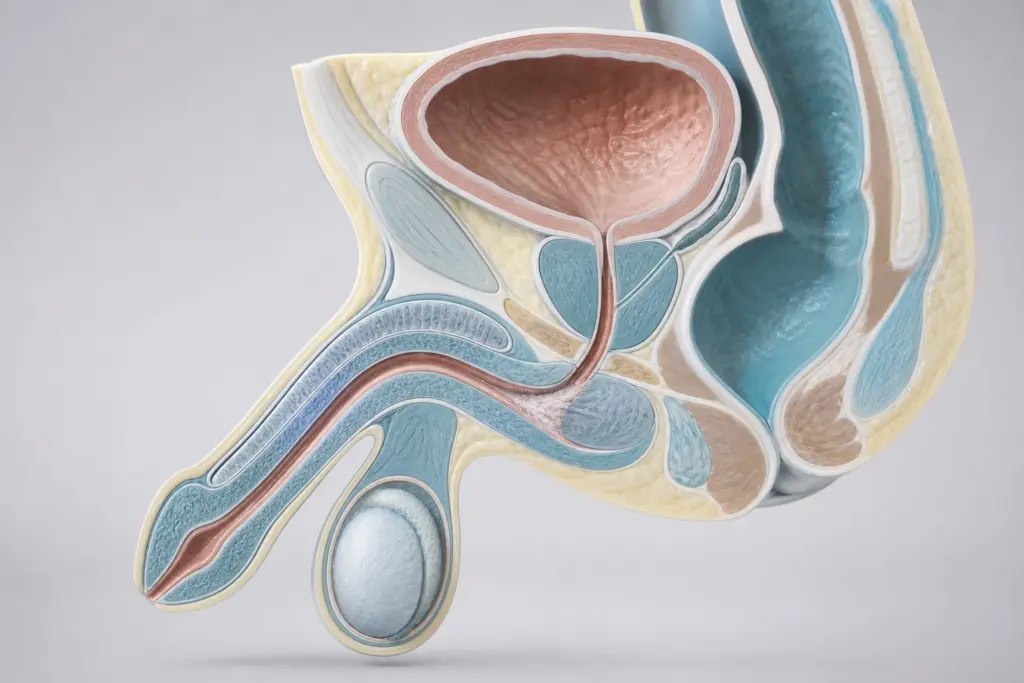
A narrowing of the urine passage that can affect urinary flow
A urethral stricture is a narrowing of the urethra — the tube that carries urine from the bladder out of the body. This narrowing can restrict urine flow and make it more difficult to empty the bladder. Symptoms can be similar to those caused by an enlarged prostate, including a weak stream, straining and incomplete bladder emptying.
Urethral strictures can occur in men of any age and are usually treatable once identified. Mr Gidon Ellis specialises in the assessment and treatment of male lower urinary tract symptoms, including difficulty passing urine, poor urinary flow and conditions affecting the urethra.
What is a urethral stricture?
The urethra is the channel that carries urine from the bladder through the penis. A urethral stricture occurs when scar tissue develops within the urethral wall, causing the passage to become narrower. This narrowing increases resistance to urine flow and may prevent the bladder from emptying efficiently.
What causes urethral strictures?
Urethral strictures are usually caused by scarring within the urethra.
Possible causes include:
Previous procedures or instrumentation
Urethral scarring can occur after procedures involving instruments passed through the urethra, including:
- Catheter insertion
- Cystoscopy
- Prostate surgery
- Other urinary procedures
Injury or trauma
Injury to the urethra or pelvis can sometimes result in scar formation.
Infection or inflammation
Previous urethral infections or inflammatory conditions can contribute to scarring.
Sometimes no clear cause is identified
In many men, despite careful assessment, the exact reason for a stricture is not known.
What symptoms can a urethral stricture cause?
Symptoms depend on the severity and location of the narrowing.
Common symptoms include:
- Weak urinary stream
- Difficulty starting urination
- Straining to pass urine
- A stop-start urinary stream
- Spraying of the urine stream
- A feeling of incomplete bladder emptying
- Post-void dribbling
- Increased urinary frequency
- Recurrent urinary tract infections
Some men notice symptoms gradually worsening over months or years.
How is a urethral stricture diagnosed?
Diagnosis involves understanding the pattern of symptoms and assessing how urine is flowing.
Investigations may include:
Uroflowmetry (urine flow test)
This measures the speed and pattern of urinary flow. A reduced flow rate or an abnormal flow pattern may suggest obstruction.
Bladder scan
A bladder scan after urination measures the post-void residual urine volume — the amount of urine remaining in the bladder. This helps assess whether the bladder is emptying effectively.
Flexible cystoscopy
A flexible cystoscopy allows direct inspection of the urethra and bladder using a small camera passed through the natural urinary passage. This can identify whether a narrowing is present and assess its location and severity.
Retrograde urethrogram (RUG)
A retrograde urethrogram is a specialised X-ray investigation that uses contrast dye to outline the urethra.
It helps determine:
- The location of the narrowing
- The length of the stricture
- The severity of the obstruction
This information is particularly useful when planning treatment.
How are urethral strictures treated?
Treatment depends on:
- The location of the stricture
- Its length and severity
- Whether it has been treated previously
- Individual symptoms and preferences
Urethral dilatation
This involves gently widening the narrowed area using specialised instruments. Although it can provide symptom relief, strictures can recur after dilatation, particularly in some types of stricture.
Optical internal urethrotomy (OIU)
Also known as direct vision internal urethrotomy (DVIU), this procedure uses a small endoscopic instrument to carefully open the scar tissue. It is performed through the natural urinary passage without external cuts.
Optilume® drug-coated balloon dilatation
Optilume is a newer minimally invasive treatment option for selected urethral strictures. During the procedure, a specially designed balloon is used to widen the narrowed area. The balloon delivers a medication (Paclitaxel) locally to the scar tissue, with the aim of reducing the chance of the stricture returning. It may be particularly useful for certain recurrent strictures, although suitability depends on individual factors including the location, length and previous treatment history.
Urethroplasty
For longer, recurrent or more complex strictures, urethroplasty may offer the most durable repair. This is a reconstructive procedure that repairs or replaces the narrowed segment of urethra. It requires specialist expertise in urethral reconstruction. Where urethroplasty is the most appropriate option, Mr Ellis will discuss this with you and arrange referral to an experienced reconstructive urological surgeon to ensure you receive the most appropriate treatment.
Recovery after treatment
Recovery depends on the type of procedure performed. After endoscopic treatments such as dilatation or optical urethrotomy, most patients return home the same day and may require a temporary catheter while the urethra heals.
After more complex reconstructive surgery, recovery is longer and involves specialist follow-up. Your treatment plan will be discussed in detail before any procedure.
When should I seek advice?
You should seek assessment if you have:
- A gradually worsening urinary stream
- Increasing difficulty passing urine
- Recurrent urine infections
- Persistent incomplete bladder emptying
Urgent medical attention is required if you are unable to pass urine at all (acute urinary retention).
Why choose Mr Ellis?
Male urinary symptoms can have several different causes, and it is important not to assume that every problem is due to prostate enlargement. Mr Ellis provides specialist assessment of urinary flow problems, using targeted investigations to determine whether symptoms are related to the prostate, urethra, bladder or pelvic floor.
As an experienced endourological surgeon, Mr Ellis offers minimally invasive treatments for suitable urethral strictures, including endoscopic management and Optilume® where appropriate. For patients with longer, recurrent or complex strictures requiring reconstructive surgery, he works within a specialist network and will arrange referral to an experienced urethral reconstruction surgeon.
Urethral stricture at a glance
| Also called | Urethral narrowing |
|---|---|
| Affects | The tube carrying urine from the bladder |
| Symptoms | Weak stream, straining, incomplete emptying, recurrent infections |
| Investigated with | Flow test, bladder scan, flexible cystoscopy and retrograde urethrogram |
| Treatment options | Dilatation, optical urethrotomy, Optilume® or reconstructive surgery (urethroplasty) |
| Anaesthetic | Depends on treatment |
Frequently asked questions
Is a urethral stricture the same as an enlarged prostate?
No. Both conditions can cause difficulty passing urine and a weak stream, but they occur in different parts of the urinary tract. An enlarged prostate narrows the urethra as it passes through the prostate, whereas a urethral stricture is scarring within the urethra itself.
Can a urethral stricture come back after treatment?
Yes. Recurrence can occur, particularly after some types of endoscopic treatment. The likelihood depends on the length, location and characteristics of the stricture.
Is urethral stricture surgery painful?
Treatment is performed under anaesthesia. Recovery depends on the procedure performed, and your surgeon will discuss what to expect beforehand.
Can a urethral stricture damage the bladder or kidneys?
If severe obstruction is left untreated, it can lead to incomplete bladder emptying, urinary retention and, in some cases, complications affecting the urinary tract. Assessment and appropriate treatment can help prevent these problems.
Arrange a consultation
If you have a weak urine stream, difficulty emptying your bladder or concerns about urethral narrowing, Mr Gidon Ellis can provide specialist assessment and discuss the most appropriate next steps. A consultation can help clarify whether symptoms are related to the prostate, urethra, bladder function or another condition.