

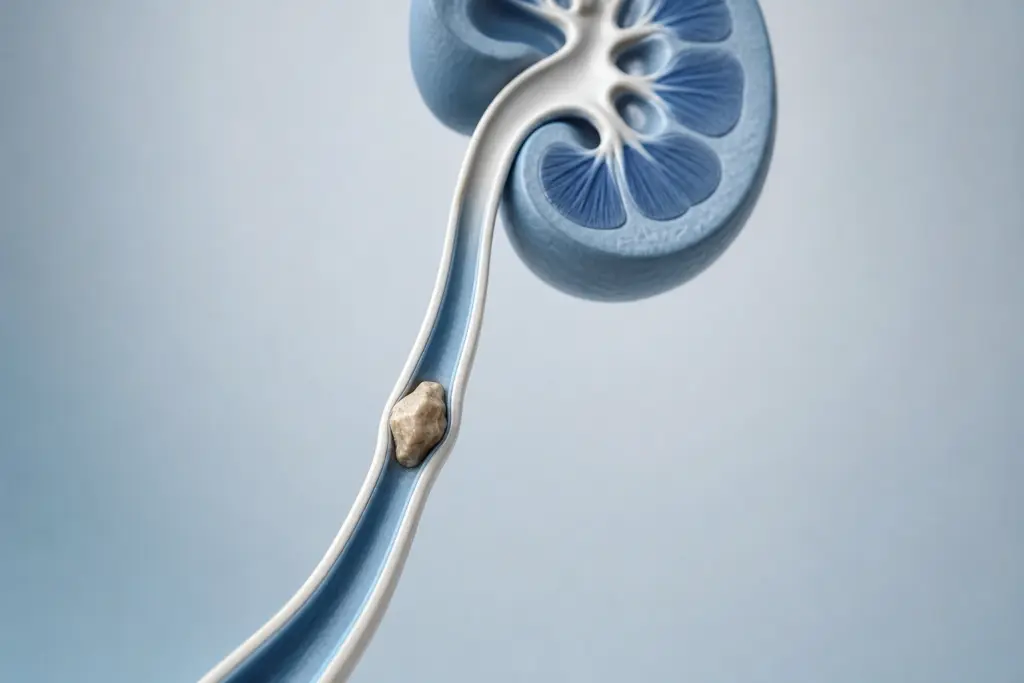
Ureteric stones are kidney stones that have moved into the ureter — the narrow tube that carries urine from the kidney to the bladder.
Unlike many kidney stones, which can remain within the kidney without causing symptoms, ureteric stones commonly cause problems because they can block the normal flow of urine. This blockage is responsible for the severe pain of renal colic and, in some cases, can lead to infection or deterioration in kidney function if not treated appropriately.
Mr Gidon Ellis is a Consultant Urological Surgeon specialising in endourology and the management of urinary stones. He provides assessment and treatment for ureteric stones, including minimally invasive treatments such as ureteroscopy and ESWL.
What is a ureteric stone?
The urinary system consists of:
- The kidneys, which produce urine
- The ureters, which transport urine from the kidneys to the bladder
- The bladder, which stores urine
- The urethra, through which urine leaves the body
A ureteric stone forms when a stone that developed within the kidney moves into the ureter. Because the ureter is narrow, even relatively small stones can become stuck and prevent urine draining normally.
What causes ureteric stones?
Most ureteric stones are formed initially within the kidney before moving into the ureter.
Factors that increase the risk of stone formation include:
- Low fluid intake
- Concentrated urine
- Dietary factors
- Family history of kidney stones
- Certain metabolic conditions
- Previous stone disease
The type of stone formed can also provide clues about why it developed.
What symptoms do ureteric stones cause?
The most characteristic symptom is renal colic — sudden, severe pain caused by the stone obstructing the ureter.
Symptoms may include:
- Severe pain in the side or back
- Pain that comes in waves or spasms
- Pain radiating towards the lower abdomen, groin or testicle
- Nausea or vomiting
- Blood in the urine
- Urinary urgency or frequency, particularly when the stone is close to the bladder
Unlike many other causes of abdominal pain, patients with renal colic are often restless and unable to find a comfortable position.
Are ureteric stones dangerous?
Many ureteric stones will pass naturally, particularly when they are small. However, a blocked ureter can become a problem if urine cannot drain properly.
Potential complications include:
Kidney obstruction
A stone blocking urine flow can cause swelling of the kidney (hydronephrosis). If obstruction persists, it can affect kidney function.
Infection behind an obstructing stone
A blocked kidney with infection is a potentially serious condition. When infected urine cannot drain because of a stone, bacteria can build up within the urinary system. In rare cases, this can lead to severe infection and sepsis, which can be life-threatening.
For this reason, an infected obstructed kidney requires urgent treatment. The priority is usually to drain the kidney and treat the infection first, rather than attempting to remove the stone immediately.
Drainage may be achieved with:
- A ureteric stent placed through the urinary tract
- A nephrostomy tube placed directly into the kidney
Once the infection has settled and it is safe to proceed, definitive treatment of the stone can be planned.
Loss of kidney function
Prolonged obstruction can affect kidney function, particularly if severe or untreated.
How are ureteric stones diagnosed?
Assessment involves confirming the presence of a stone and understanding its size, location and effect on the urinary tract.
Urine tests
These can identify:
- Blood in the urine
- Signs of infection
Blood tests
These may assess:
- Kidney function
- Signs of infection
CT KUB scan
A low-dose CT scan of the kidneys, ureters and bladder is the most accurate investigation for most patients.
It shows:
- The size of the stone
- The exact location
- Whether the kidney is obstructed
- The likelihood of natural passage
This information is essential when deciding between observation and intervention.
Will my ureteric stone pass naturally?
Some ureteric stones pass without surgery.
The likelihood depends mainly on:
- Stone size
- Stone location
- Degree of obstruction
- Symptoms
- Patient preference
Small stones, particularly those lower down in the ureter, are more likely to pass naturally. Larger stones or those causing persistent symptoms or obstruction may require treatment.
How are ureteric stones treated?
Treatment depends on:
- The size and position of the stone
- Symptoms
- Whether there is obstruction
- Whether infection is present
- Patient preference
Observation
Small stones may be managed with:
- Pain relief
- Medication where appropriate
- Follow-up imaging
ESWL (shockwave lithotripsy)
ESWL uses focused shockwaves from outside the body to break the stone into smaller fragments. It is a non-invasive treatment option for selected ureteric stones.
Ureteroscopy
Ureteroscopy involves passing a small telescope through the urinary passage to directly access the stone.
The stone is usually:
- Fragmented using a laser
- Removed using specialised instruments
A temporary ureteric stent is often placed afterwards to allow the ureter to heal and urine to drain normally.
What happens if a ureteric stone needs urgent treatment?
Urgent treatment may be required if there is a concern that the kidney is obstructed and unable to drain safely, particularly when infection is present.
This may include:
- Infection behind an obstructing stone
- Severe uncontrolled pain
- Worsening kidney function
- Inability to pass urine
In these situations, the immediate priority is usually to relieve the blockage and protect the kidney.
This may involve:
- Ureteric stent insertion
- Nephrostomy drainage
The stone can then usually be treated once it is safe to do so.
Can ureteric stones be prevented?
Because ureteric stones usually originate from kidney stones, prevention focuses on reducing the chance of future stone formation.
This may include:
- Increasing fluid intake
- Dietary optimisation
- Stone analysis
- Metabolic assessment in selected patients
At a glance
| Also called | Ureteral stone, ureteric calculus |
|---|---|
| Usually caused by | A kidney stone moving into the ureter |
| Typical symptoms | Renal colic, flank pain, nausea, blood in urine |
| Diagnosed with | CT KUB, urine tests, blood tests |
| Treatment | Observation, ESWL or ureteroscopy |
| Urgent concerns | Infection with obstruction, uncontrolled pain or kidney impairment |
Have you been diagnosed with a ureteric stone?
Ureteric stones are common and highly treatable. Specialist assessment can help determine whether your stone is likely to pass naturally or whether treatment is recommended. Book a consultation to discuss your symptoms and treatment options.