

Minimally invasive surgery to remove bladder tumours
Mr Gidon Ellis is a Consultant Urological Surgeon in London specialising in the diagnosis and minimally-invasive treatment of bladder and upper urinary tract conditions, including the endoscopic management of bladder tumours. Transurethral resection of bladder tumour (TURBT) is a minimally invasive operation used to remove bladder tumours through the natural urinary passage.
It is commonly the first surgical treatment for a bladder tumour and also provides important tissue for laboratory analysis. The results help establish the nature and extent of the tumour and determine whether further treatment is required.
What is TURBT?
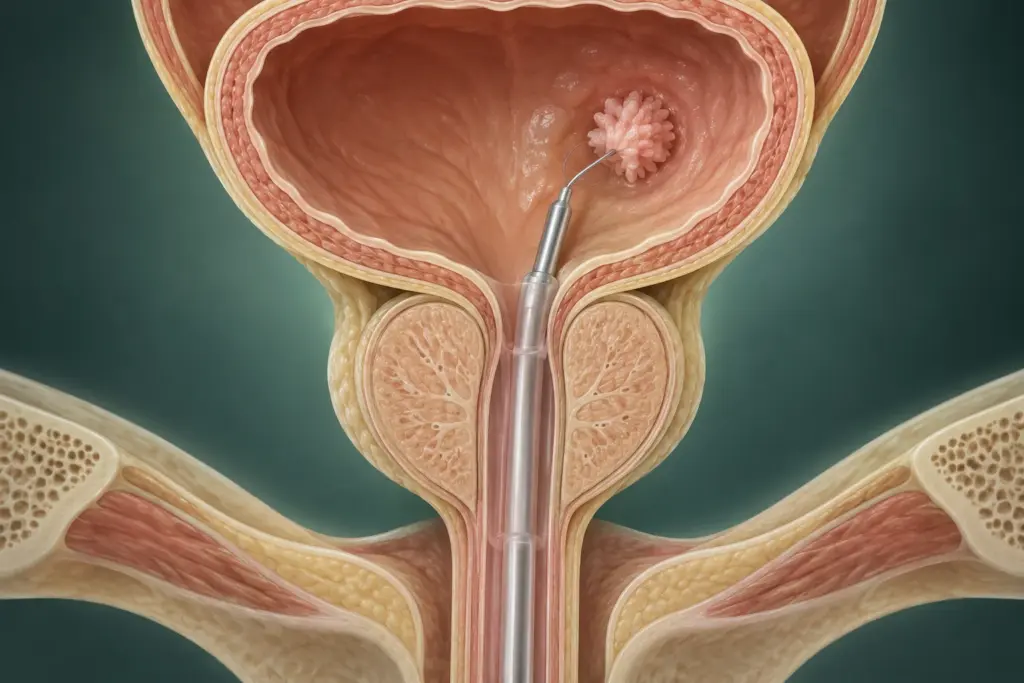
TURBT is performed by passing a specialised telescope through the urethra into the bladder. There are no external cuts or incisions. The surgeon identifies the bladder tumour and uses specialised instruments passed through the telescope to remove the tumour from the bladder lining.
The procedure is usually performed under general or regional anaesthetic. The removed tissue is sent to the laboratory for detailed pathological examination.
Why is TURBT performed?
TURBT may be recommended when:
- A bladder tumour has been identified during cystoscopy
- A bladder tumour is suspected based on imaging or other investigations
- A previously diagnosed bladder tumour needs further assessment
- A tumour needs to be removed to establish its depth and characteristics
The aim is both to remove the visible tumour and to obtain sufficient tissue to establish how the tumour behaves and whether it has invaded the bladder muscle.
What happens during TURBT?
Before the procedure, your surgeon will discuss the reason for TURBT and what is expected to happen. You will normally need to fast before the anaesthetic.
During the operation:
- A telescope is passed through the urethra into the bladder.
- The bladder is examined carefully.
- The tumour is identified and removed using specialised instruments.
- The tumour tissue is sent for pathological analysis.
- The bladder is checked for any remaining visible tumour or other abnormalities.
A urinary catheter is usually left in place temporarily following the procedure. In some patients, medication may be placed directly into the bladder after TURBT. Whether this is appropriate depends on the characteristics of the tumour and the individual circumstances.
What are the risks of TURBT?
TURBT is generally a safe and well-established procedure, but complications can occur.
Possible risks include:
- Blood in the urine
- Urinary tract infection
- Temporary difficulty passing urine
- Bladder irritation or urgency
- Bleeding requiring further treatment
- Injury or perforation of the bladder, which is uncommon
- The need for a further procedure
The risks depend partly on the size, number and location of the tumours and the extent of the resection. Your individual risks will be discussed before surgery.
What happens after TURBT?
Most patients can go home on the same day or after a short hospital stay, depending on the extent of the procedure and their individual circumstances.
It is common to experience:
- Burning or stinging when passing urine
- Increased urinary frequency or urgency
- A small amount of blood in the urine
- Mild bladder discomfort
These symptoms usually improve over the following days. A catheter may remain in place for a short period, particularly if there has been extensive tumour removal or significant bleeding. Your surgeon will explain when you can return to normal activities.
Will I need a second TURBT?
Sometimes.
A further TURBT may be recommended when:
- The initial tumour was large or extensive
- The tumour was high risk
- The initial procedure did not provide sufficient tissue for accurate staging
- There is concern that tumour may remain
- The pathology results indicate that further assessment is required
A second procedure can provide additional information and help ensure that the tumour has been adequately removed.
What does the pathology report tell us?
The laboratory examines the removed tissue under a microscope.
The pathology report provides important information about the tumour, including:
Type
Most bladder tumours are urothelial carcinomas, although other less common types of bladder cancer can occur.
Grade
Grade describes how abnormal the cancer cells look and provides information about how aggressively the tumour is likely to behave.
Stage
Stage describes how deeply the tumour has grown into the bladder wall.
One of the most important distinctions is whether the tumour is:
- Non-muscle-invasive – confined to the inner layers of the bladder
- Muscle-invasive – has grown into the muscular wall of the bladder
The pathology results, together with the number, size and appearance of tumours, are used to determine the next stage of treatment.
What happens after the pathology results?
The pathology results are an important part of deciding what happens next. Some patients require no immediate additional treatment apart from surveillance.
Others may require further treatment within the bladder, a further TURBT or more extensive treatment depending on the grade and stage of the tumour. Treatment decisions are usually discussed through a specialist multidisciplinary team (MDT) where appropriate.
For non-muscle-invasive bladder cancer, further treatment may include medication delivered directly into the bladder and regular surveillance cystoscopy. For muscle-invasive or more advanced disease, treatment may involve major surgery, radiotherapy, chemotherapy, immunotherapy or combinations of these treatments.
Frequently asked questions
Is TURBT the same as cystoscopy?
No. Cystoscopy is primarily an examination of the bladder and urethra using a telescope. TURBT is a surgical procedure in which a bladder tumour is removed through the telescope. A cystoscopy may identify a tumour, after which TURBT is performed to remove it and obtain tissue for pathological analysis.
Is TURBT performed under general anaesthetic?
Usually. TURBT is generally performed under general or regional anaesthetic because it is a surgical procedure involving removal of bladder tissue.
How long does TURBT take?
The duration varies depending on the size, number and location of the tumours and the complexity of the procedure.
Will I need a catheter after TURBT?
Usually, at least temporarily. The catheter allows the bladder to drain while the bladder lining heals and helps monitor or manage bleeding. The catheter is usually removed once the urine is sufficiently clear and you are passing urine safely.
Does TURBT cure bladder cancer?
TURBT can completely remove some bladder tumours, particularly non-muscle-invasive tumours. However, bladder cancer can recur, and some patients require additional treatment or regular surveillance after TURBT. The need for further treatment depends on the tumour’s pathology and risk of recurrence or progression.
Will I need further treatment after TURBT?
Possibly. Some patients require only surveillance, while others may need further TURBT, medication delivered into the bladder or more extensive treatment. The pathology results are central to making this decision.
Can bladder tumours come back after TURBT?
Yes. Recurrence is relatively common with bladder cancer, particularly with non-muscle-invasive disease. For this reason, regular surveillance cystoscopy is often required following treatment.
TURBT at a glance
| Full name | Transurethral Resection of Bladder Tumour |
|---|---|
| Purpose | Removal and pathological assessment of bladder tumours |
| Approach | Through the urethra, without external incisions |
| Anaesthetic | Usually general or regional anaesthetic |
| Catheter | Usually required temporarily |
| Hospital stay | Day case or short stay, depending on the procedure |
| Further treatment | Depends on tumour grade, stage and risk of recurrence |
| Follow-up | Surveillance cystoscopy is often required |
Arrange a consultation
If you have been diagnosed with a bladder tumour or have been advised that you require TURBT, Mr Gidon Ellis offers specialist assessment and endoscopic management of bladder tumours in London. A consultation provides an opportunity to discuss the findings from your cystoscopy or scans, explain what TURBT involves and discuss what may happen after the pathology results are available.