

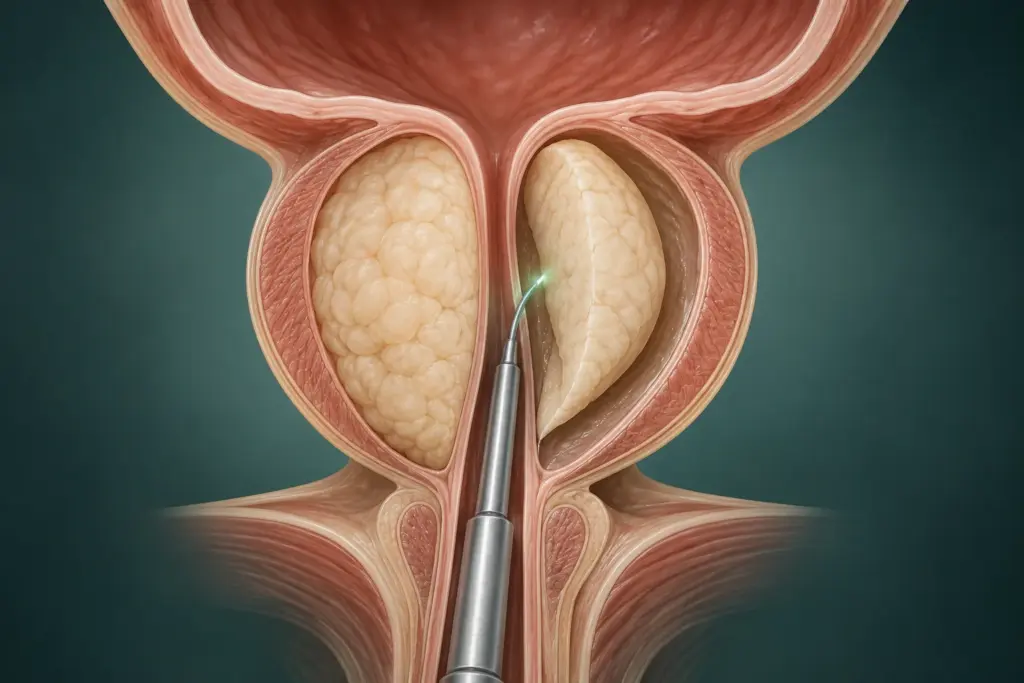
Laser surgery for an enlarged prostate
Mr Gidon Ellis is a Consultant Urological Surgeon in London specialising in the treatment of benign prostatic hyperplasia (BPH), including Holmium Laser Enucleation of the Prostate (HoLEP). HoLEP is an advanced laser operation used to treat urinary symptoms caused by an enlarged prostate. It is one of the most effective and durable surgical treatments available for men with bladder outflow obstruction due to BPH.
What is HoLEP?
Holmium Laser Enucleation of the Prostate (HoLEP) is a minimally invasive procedure that removes the part of the prostate responsible for blocking the flow of urine. During the procedure, a specialised holmium laser is passed through the urethra (the natural urinary passage) to carefully separate the enlarged prostate tissue from the outer capsule of the prostate. The removed tissue is then extracted using a specialised instrument called a morcellator.
Unlike traditional open prostate surgery, HoLEP does not require any external cuts or incisions. Because it removes the obstructing prostate tissue completely, it provides a durable improvement in urinary symptoms and urine flow.
Who can benefit from HoLEP?
HoLEP is suitable for many men with urinary symptoms caused by an enlarged prostate, particularly when symptoms are significantly affecting quality of life or when complications have developed.
- Symptoms that may improve after HoLEP include:
- A weak or slow urinary stream
- Difficulty starting urination
- Straining to pass urine
- A feeling that the bladder does not empty completely
- Frequent urination during the day
- Waking several times at night to pass urine (nocturia)
- Urgency and difficulty postponing urination
- Recurrent urine infections related to incomplete bladder emptying
- Urinary retention requiring a catheter HoLEP can treat prostates of almost any size, including very large prostates that historically may have required open surgery.
What are the advantages of HoLEP?
HoLEP has become an established treatment option for benign prostatic enlargement because of its combination of effectiveness, durability and minimally invasive approach. Potential advantages include:
Long-lasting improvement
HoLEP removes the obstructing prostate tissue rather than simply creating a channel through it. This provides excellent long-term relief from urinary obstruction, with very low rates of needing further prostate surgery in the future.
Suitable for prostates of all sizes
Unlike some other prostate procedures, HoLEP is not limited by prostate size and can be used successfully for both smaller and very large prostates.
Less bleeding than traditional prostate surgery
The laser seals blood vessels during the procedure, which can reduce bleeding compared with some traditional surgical techniques. This can be particularly beneficial for selected patients who take blood-thinning medication.
Short hospital stay and rapid recovery
Most men stay in hospital for one night following HoLEP, although carefully selected patients may be suitable for a day-case pathway.
Recovery after HoLEP
A urinary catheter is usually removed later on the day of surgery or the following morning, depending on the individual circumstances. Many men notice a stronger urinary stream immediately after the catheter is removed. It is common to experience some burning when passing urine, increased frequency, urgency or intermittent blood in the urine during the early recovery period while the prostate heals.
Most patients return to desk-based work and normal daily activities within one to two weeks. Strenuous exercise, heavy lifting and cycling are usually avoided for approximately three to four weeks. Mr Ellis will review your progress after surgery and provide guidance throughout your recovery.
Is HoLEP the right treatment for me?
Although HoLEP is an excellent treatment for the great majority of men with an enlarged prostate, the right choice depends on your prostate size, symptoms, general health and personal priorities. HoLEP is often particularly well suited to:
- Men with very large prostates, where other techniques may be less effective or not possible
- Men taking blood-thinning medication, given the reduced bleeding compared with traditional surgery
- Men seeking the most durable long-term result, with a low chance of needing further prostate surgery
- Men with urinary retention or recurrent infections related to incomplete bladder emptying
For men whose main priority is preserving ejaculatory function above all else, or who have a smaller prostate, an alternative such as Aquablation may also be worth discussing. Mr Ellis will talk through your individual circumstances, prostate size and priorities to help you decide whether HoLEP or an alternative treatment is the best fit.
What are the risks of HoLEP?
As with any prostate procedure, HoLEP carries some risks, which Mr Ellis will discuss with you in detail. These can include:
- Bleeding, occasionally requiring a return to theatre or transfusion
- Infection
- Temporary urinary symptoms such as urgency, frequency or burning
- Retrograde ejaculation (semen entering the bladder rather than leaving the body during ejaculation), which occurs in the majority of men after HoLEP
- A small risk of urinary incontinence, usually temporary
- Rarely, injury to the urethra requiring further treatment