

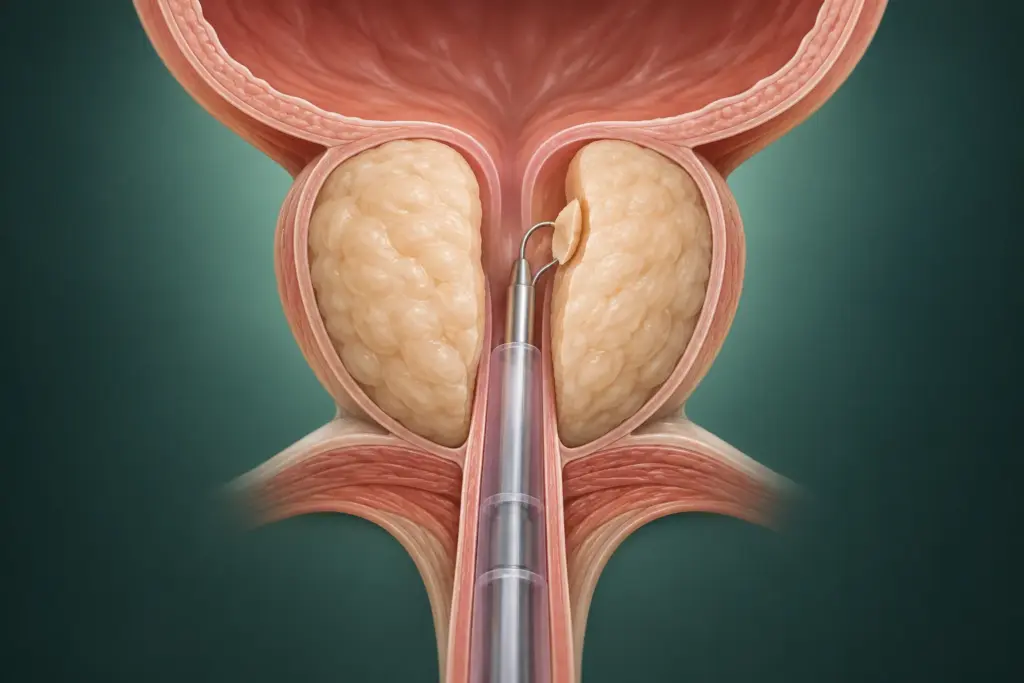
An established surgical treatment for an enlarged prostate
Mr Gidon Ellis is a Consultant Urological Surgeon in London specialising in the treatment of benign prostatic hyperplasia (BPH), including surgical treatments such as TURP, HoLEP and Aquablation. Transurethral Resection of the Prostate (TURP) is one of the most established operations for treating urinary symptoms caused by an enlarged prostate. It has been performed successfully for many decades and remains an effective treatment for men with bladder outflow obstruction due to benign prostatic enlargement.
What is TURP?
TURP is a minimally invasive operation that removes the part of the prostate blocking the flow of urine. During the procedure, a small surgical instrument is passed through the urethra (the natural urinary passage). Using a specialised cutting loop, the surgeon removes small pieces of prostate tissue to create a wider channel for urine to pass through.
There are no external cuts or incisions. The procedure is performed using bipolar energy.
Who can benefit from TURP?
TURP may be recommended for men with bothersome urinary symptoms caused by an enlarged prostate, particularly when symptoms have not improved sufficiently with medication.
Symptoms that may improve after TURP include:
- A weak urinary stream
- Difficulty starting urination
- Straining to pass urine
- A sensation of incomplete bladder emptying
- Frequent urination
- Waking at night to pass urine (nocturia)
- Urgency
- Urinary retention requiring a catheter
TURP is generally most suitable for men with small to moderately enlarged prostates, although the best treatment depends on individual anatomy, symptoms and overall health.
What are the advantages of TURP?
A well-established treatment
TURP has a long history of successful use and remains one of the most thoroughly studied operations for benign prostate enlargement.
Effective improvement in urinary symptoms
For appropriately selected patients, TURP provides significant improvement in urine flow and quality of life by relieving obstruction caused by prostate enlargement.
Minimally invasive approach
Because TURP is performed through the natural urinary passage, there are no external wounds and recovery is usually quicker than traditional open prostate surgery.
Widely available treatment
TURP is offered in many hospitals and remains an important treatment option for men with BPH.
Recovery after TURP
Most patients stay in hospital for one to two nights following TURP, although this may vary depending on individual circumstances. A urinary catheter is usually left in place after surgery and is commonly removed once the urine is clear. It is normal to experience some burning when passing urine, increased frequency, urgency or intermittent blood in the urine during the early recovery period.
Most men return to lighter activities within one to two weeks, although complete healing of the prostate takes longer. Strenuous exercise and heavy lifting are usually avoided for several weeks. Mr Ellis will review your recovery and urinary improvement following surgery.
TURP, HoLEP or Aquablation: which is right for me?
There are several effective surgical treatments for an enlarged prostate, and the best choice depends on your prostate size, symptoms, bladder function, medical history and personal priorities. TURP remains an excellent option for many men, particularly those with smaller or moderately enlarged prostates.
HoLEP offers the advantage of being suitable for prostates of almost any size and has excellent long-term durability. Aquablation may be attractive for selected men who place particular importance on preservation of ejaculation. During consultation, Mr Ellis will discuss the advantages and limitations of each approach to help you make an informed decision.
TURP at a glance
| Full name | Transurethral Resection of the Prostate |
|---|---|
| Treats | Enlarged prostate (benign prostatic hyperplasia, BPH) |
| Procedure | Removal of obstructing prostate tissue through the urethra using a surgical cutting loop |
| Anaesthetic | General or spinal anaesthetic |
| Hospital stay | Usually one night |
| Catheter | Usually removed the following day |
| Recovery | Most normal activities within 2–4 weeks |
Frequently asked questions about TURP
Does TURP improve urinary flow?
Yes. By removing the obstructing prostate tissue, TURP usually results in a significant improvement in urine flow and bladder emptying.
Does TURP affect ejaculation?
Retrograde ejaculation (dry orgasm) is a common side effect after TURP. This means semen travels backwards into the bladder during orgasm rather than coming out through the penis. It does not usually affect sexual pleasure or erections, but it can affect fertility.
Is TURP still performed today?
Yes. Although newer techniques such as HoLEP and Aquablation have expanded the range of available treatments, TURP remains an effective and widely used operation with a strong evidence base.
How long do the benefits of TURP last?
Many men experience long-lasting improvement after TURP. However, because some prostate tissue remains, a small proportion of men may require further treatment in the future.
Arrange a consultation
If you are experiencing urinary symptoms caused by an enlarged prostate, Mr Gidon Ellis offers specialist assessment in London to help you understand the available treatment options. A consultation provides an opportunity to discuss whether TURP, HoLEP, Aquablation or another approach is most suitable for your individual circumstances.