

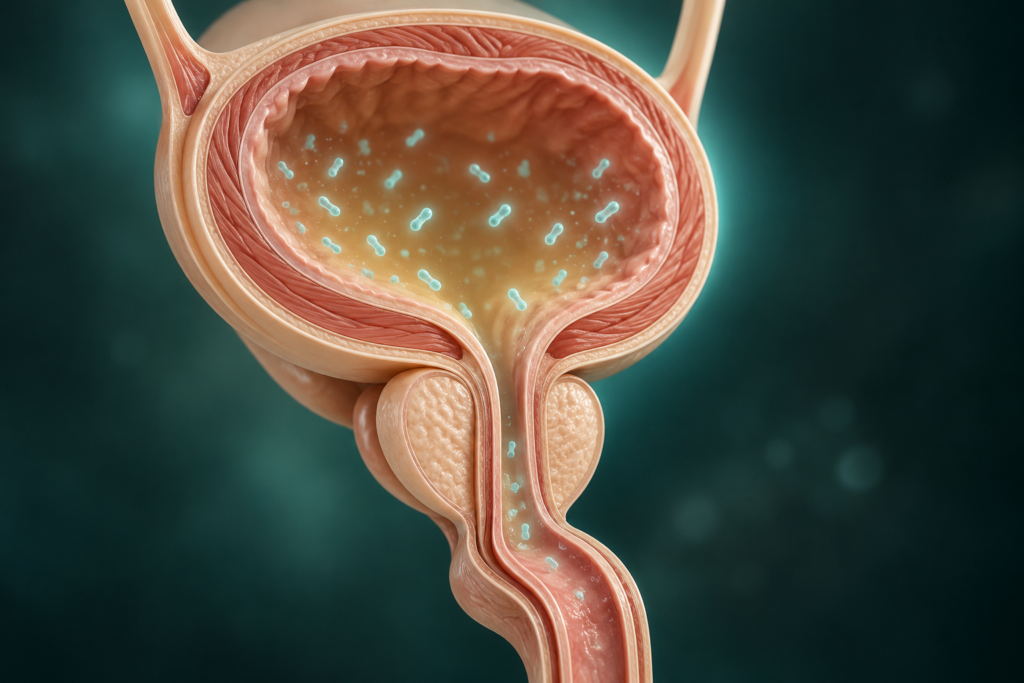
Having one urinary tract infection (UTI) is common. But if infections keep coming back, it is worth asking why.
Recurrent urinary tract infections can be frustrating, particularly when symptoms return soon after completing antibiotics. Although some people are simply more prone to infections, recurrent UTIs can sometimes indicate an underlying problem affecting the way urine is stored, transported or emptied.
Understanding the reason for recurrent infections is important because treating the underlying cause may help reduce the likelihood of further episodes.
What is a recurrent UTI?
Recurrent UTI is generally defined as:
- Two or more symptomatic, medically confirmed UTIs within six months, or
- Three or more symptomatic, medically confirmed UTIs within 12 months
It is important that the episodes are genuinely infections rather than repeated treatment of symptoms that have another cause.
Is it definitely a UTI?
This is an important question when urinary symptoms keep returning.
Not every episode of burning, frequency or urgency is caused by a urinary infection.
Conditions that can produce similar symptoms include:
- Overactive bladder
- Bladder outflow obstruction
- Prostatitis
- Urinary tract stones
- Urethral stricture
- Pelvic floor dysfunction
- Bladder pain syndrome
Repeated courses of antibiotics are unlikely to solve the problem if the underlying cause is not infection.
For this reason, recurrent symptoms should ideally be assessed with appropriate urine testing rather than assuming every episode represents another UTI.
Where recurrent infections are suspected, documenting episodes with urine cultures can be particularly useful.
Why do UTIs keep coming back?
There are several possible reasons for recurrent urinary infections.
Incomplete bladder emptying
One possible cause is incomplete emptying of the bladder.
Normally, most urine is emptied when you pass urine. If significant urine remains in the bladder afterwards, bacteria may have an opportunity to multiply and cause infection.
Incomplete emptying can occur for a number of reasons, including problems affecting the bladder, the outlet from the bladder or the nerves controlling the urinary system.
A simple bladder scan after urination can measure the amount of urine left behind.
Urinary tract stones
Kidney and urinary tract stones can sometimes contribute to recurrent infections.
Stones may:
- Harbour bacteria
- Irritate the urinary tract
- Interfere with normal urine drainage
- Cause obstruction
Recurrent infections associated with urinary tract stones may therefore require investigation to determine whether the stone needs treatment.
Related: Kidney Stones
Structural abnormalities
Abnormalities within the urinary tract can sometimes make infections more likely.
These may affect:
- The kidneys
- Ureters
- Bladder
- Urethra
Examples include narrowing, abnormal drainage, urinary obstruction or bladder diverticula.
The appropriate investigations depend on the individual’s symptoms and medical history.
Why are recurrent UTIs different in men?
Recurrent UTIs are much more common in women, partly because the female urethra is considerably shorter.
When a man develops recurrent, medically confirmed UTIs, it is therefore particularly important to consider whether there is an underlying urological cause.
Possible causes include:
- Incomplete bladder emptying
- An enlarged prostate or bladder outflow obstruction
- Urinary tract stones
- Urethral stricture
- Prostate infection or inflammation
Repeated courses of antibiotics may treat individual infections but will not necessarily address the reason they are recurring.
For this reason, recurrent UTIs in men may warrant assessment of bladder emptying and, where appropriate, further investigation.
Can an enlarged prostate cause recurrent UTIs?
Yes.
An enlarged prostate can narrow the channel through which urine leaves the bladder, causing bladder outflow obstruction.
Some men compensate well and continue to empty their bladder reasonably effectively. Others develop significant residual urine.
In these patients, incomplete emptying may contribute to recurrent urinary infections.
Treating the underlying obstruction may therefore be an important part of preventing further infections rather than simply treating each infection as it occurs.
Related: Bladder Outflow Obstruction
Related: Enlarged Prostate / BPH
Could the prostate be responsible?
In men, recurrent urinary symptoms or infections can sometimes be associated with inflammation or infection involving the prostate.
Prostatitis can cause symptoms such as:
- Burning when passing urine
- Frequency and urgency
- Difficulty passing urine
- Pelvic or perineal discomfort
- Pain during or after ejaculation
- Fever and systemic illness in acute cases
The diagnosis and treatment of prostatitis can be more complex than those of a straightforward bladder infection.
How are recurrent UTIs investigated?
The investigation depends on your symptoms, age, sex and medical history.
Urine testing
A urine sample can help confirm whether bacteria are present and, where appropriate, identify which antibiotics are likely to be effective.
Where recurrent infections are suspected, documenting infections with urine cultures can be particularly useful.
Bladder scan
A bladder scan after passing urine can measure the post-void residual volume — the amount of urine left in the bladder.
This is a simple and non-invasive way of assessing whether incomplete bladder emptying may be contributing to recurrent infection.
Urine flow test
Uroflowmetry measures the speed and pattern of urine flow.
It can provide useful information about bladder emptying and possible bladder outflow obstruction, particularly in men with urinary symptoms.
Imaging
An ultrasound or CT scan may be recommended where there is concern about:
- Kidney or bladder stones
- Urinary obstruction
- Abnormal kidney drainage
- Structural abnormalities
Further investigations
Depending on the circumstances, additional tests such as flexible cystoscopy may be appropriate.
The aim is not to perform every test on every patient, but to identify investigations that are relevant to the likely underlying cause.
How can recurrent UTIs be prevented?
Prevention depends on the reason the infections are occurring.
Stay well hydrated
Regular fluid intake helps maintain urine flow and may reduce the concentration of bacteria within the urinary tract.
Don’t regularly delay passing urine
Passing urine regularly can help maintain normal bladder function.
Address incomplete bladder emptying
If significant residual urine is present, identifying and treating the cause may reduce the risk of further infections.
Treat underlying urinary tract problems
This may include treating:
- Bladder outflow obstruction
- Urinary tract stones
- Urethral strictures
- Other structural abnormalities
Use antibiotics appropriately
Repeated antibiotic treatment should be guided by appropriate clinical assessment and, where possible, urine culture results.
The goal is to treat genuine infections while avoiding unnecessary antibiotic exposure.
When should recurrent UTIs be investigated?
Further assessment is particularly worth considering if:
- You have repeated medically confirmed UTIs
- You are a man with recurrent UTIs
- Infections keep returning despite appropriate antibiotic treatment
- You have difficulty emptying your bladder
- You have blood in your urine
- You have a history of urinary stones
- You have significant urinary symptoms between infections
- You develop fever, loin pain or feel significantly unwell with an infection
The aim is to identify and treat any underlying cause rather than simply treating each infection individually.
What if I have a UTI with a blocked kidney?
A kidney that is blocked by a stone or another obstruction and is also infected can become a urological emergency.
Infected urine trapped behind an obstruction can occasionally lead to severe infection and sepsis.
In this situation, the immediate priority is usually to drain the kidney and treat the infection. Definitive treatment of the underlying obstruction can then be undertaken once it is safe to do so.
The important message about recurrent UTIs
If you keep getting UTIs, the answer is not necessarily another course of antibiotics.
Sometimes there is a straightforward explanation, such as incomplete bladder emptying, an underlying urinary tract stone or another structural problem. In other cases, the symptoms may not actually be caused by infection.
A careful assessment can establish whether infections are genuinely recurring and, if so, whether there is an underlying problem that can be treated to reduce the likelihood of further episodes.
At a glance
Recurrent UTI: Two or more confirmed infections within six months, or three or more within 12 months
Possible causes: Incomplete bladder emptying, urinary tract stones, structural abnormalities and, in men, prostate problems or other urological conditions
Investigations may include: Urine culture, bladder scan, urine flow test, ultrasound or CT and, where appropriate, cystoscopy
Particularly important in: Anyone with recurrent infections; men with recurrent UTIs may warrant particular assessment for an underlying urological cause
Goal of treatment: Confirm the infection, identify any underlying cause and reduce the risk of recurrence
Reviewed by: Mr Gidon Ellis Consultant Urological Surgeon