

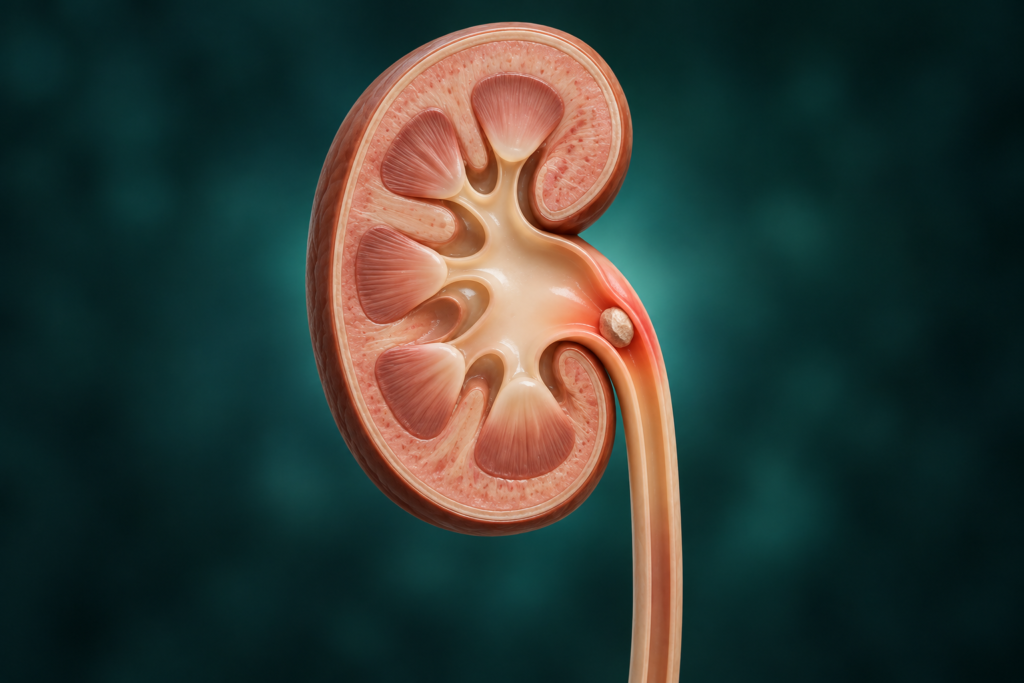
Kidney stones are common and, although they can cause severe pain, most are not dangerous and can be managed safely with appropriate assessment and treatment.
However, there is one situation where a kidney stone becomes a medical emergency: when a stone blocks the urinary system and infection develops behind the blockage.
This is known as an infected obstructed kidney and requires urgent treatment to protect the kidney and prevent serious complications.
Mr Gidon Ellis is a Consultant Urological Surgeon specialising in endourology and the management of urinary stones. He provides assessment and treatment for kidney and ureteric stones, working closely with specialist colleagues where required to ensure patients receive comprehensive care.
Why is an infected obstructed kidney different from a normal kidney stone?
Most kidney stones cause problems because they obstruct the ureter and trigger severe pain (renal colic).
Although the pain can be intense, many patients with an uncomplicated ureteric stone can be managed safely with pain relief, monitoring and planned treatment if the stone does not pass.
The situation changes when infection is present.
A stone blocking the ureter prevents urine from draining normally. If bacteria are present within the urine, they can become trapped behind the blockage.
This creates a closed, pressurised system where infection can worsen quickly.
Why can an infected obstructed kidney be dangerous?
When infected urine cannot drain from the kidney, the infection can occasionally spread beyond the urinary system and into the bloodstream.
This can lead to sepsis, a potentially life-threatening response to infection.
For this reason, an infected obstructed kidney requires urgent medical assessment and treatment.
The priority is not initially to remove the stone. The priority is to:
- Drain the blocked kidney
- Treat the infection with antibiotics
- Stabilise the patient
- Treat the stone once it is safe to do so
What symptoms should make me seek urgent help?
A kidney stone may cause severe pain, but certain symptoms raise concern for infection.
Seek urgent medical advice if you have a suspected kidney stone and develop:
- Fever or chills
- Feeling generally unwell
- Increasing weakness or confusion
- Persistent vomiting
- Worsening pain despite medication
- Difficulty passing urine
It is particularly important to seek urgent help if you have been told that your kidney is blocked or that there is swelling of the kidney (hydronephrosis).
How is an infected obstructed kidney treated?
The immediate treatment goal is to relieve the blockage and allow infected urine to drain.
This is usually achieved by one of two methods:
Ureteric stent insertion
A small tube is placed internally through the bladder and ureter to bypass the blockage and allow urine to drain from the kidney.
Nephrostomy drainage
A small tube is placed directly through the skin into the kidney to drain urine externally.
The choice depends on the individual situation, anatomy, urgency and local expertise.
Once the infection has settled and the patient has recovered, the stone can be treated definitively.
Why isn't the stone removed immediately?
A common question is:
“Why not just remove the stone and fix the problem straight away?”
In an infected obstructed kidney, attempting to remove the stone immediately can increase the risk of spreading bacteria into the bloodstream.
The safest approach is usually:
- Drain first
- Treat infection
- Remove the stone later
The timing of definitive stone treatment depends on recovery, the size and location of the stone and the most appropriate treatment option.
What happens after the infection has settled?
Once the kidney has been safely drained and the infection treated, the underlying stone still requires attention.
The options depend on:
- Stone size
- Stone location
- Symptoms
- Kidney function
- Patient preference
Treatment may include:
- Observation in selected cases
- ESWL (shockwave lithotripsy)
- Ureteroscopy with laser treatment
Related: Ureteroscopy
Can an infected obstructed kidney be prevented?
Not every infected obstructed kidney can be predicted or prevented.
However, seeking medical advice early when symptoms develop can reduce the risk of complications.
Patients with recurrent kidney stones may benefit from assessment to understand why stones are forming and how future episodes can be prevented.
Key points
- Most kidney stones are painful but not emergencies.
- A blocked kidney with infection is different and requires urgent treatment.
- The priority is to drain the kidney and treat the infection before removing the stone.
- Early recognition and treatment can prevent serious complications.
Worried about a kidney stone?
If you have been diagnosed with a kidney or ureteric stone, specialist assessment can help determine whether your stone is likely to pass naturally or whether treatment is recommended.
Book a consultation to discuss your symptoms, scan findings and treatment options.