

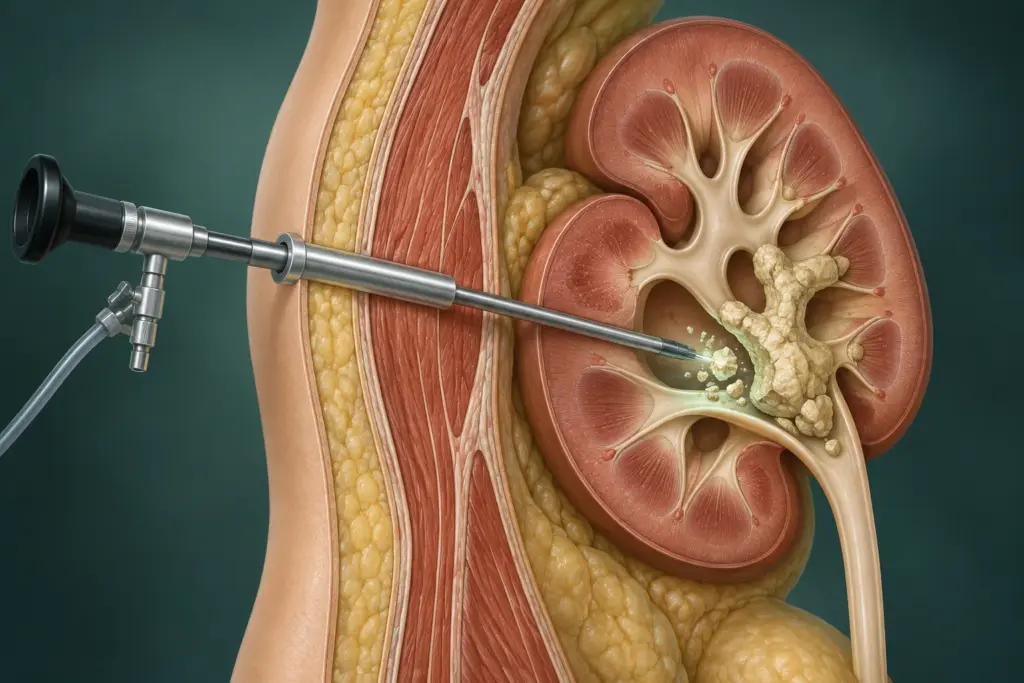
Percutaneous nephrolithotomy (PCNL) is a minimally invasive keyhole procedure used to treat larger or more complex kidney stones. PCNL is a keyhole procedure where a small access is made through the skin in the back to reach the kidney directly. This allows larger stones to be removed efficiently in a single procedure. PCNL is one of the most effective treatments for large kidney stones and is an important part of modern endourological stone care.
Mr Gidon Ellis is a Consultant Urological Surgeon specialising in endourology and kidney stone management. He provides assessment and treatment for kidney stones and works closely with specialist stone surgeons who perform PCNL when this is the most appropriate treatment option.
What is PCNL?
Percutaneous nephrolithotomy means:
- Percutaneous – through the skin
- Nephro – relating to the kidney
- Lithotomy – removal of stones
During PCNL, a small incision is made in the back and a narrow channel is created into the kidney. A camera is passed through this channel, allowing the surgeon to directly visualise and remove the stone. Large stones can be broken into smaller fragments using energy devices such as a laser or ultrasonic lithotripter before being removed.
When is PCNL recommended?
PCNL is usually considered when kidney stones are too large or complex to be treated effectively with simpler approaches.
Common indications include:
- Kidney stones larger than approximately 2 cm
- Staghorn stones (large branching stones occupying part of the kidney drainage system)
- Multiple large kidney stones
- Stones that have not responded to ESWL or ureteroscopy
- Certain anatomical situations where PCNL offers the best chance of complete stone clearance
The ideal treatment depends on factors including:
- Stone size
- Stone location
- Stone composition
- Kidney anatomy
- Previous treatments
- Patient preferences
What happens during PCNL?
PCNL is performed under a general anaesthetic.
The procedure usually involves:
- Accessing the kidney through a small incision in the back
- Passing a camera into the kidney
- Breaking the stone into smaller pieces
- Removing stone fragments
- Ensuring urine can drain safely afterwards
At the end of the procedure, some patients may require:
- A temporary ureteric stent
- A nephrostomy tube (a drainage tube from the kidney through the back)
These are usually temporary and removed once the kidney has recovered.
What are the advantages of PCNL?
The main advantage of PCNL is its ability to treat large stone burdens effectively.
Benefits include:
- High stone clearance rates for large kidney stones
- Often completed in a single treatment
- Avoids the need for multiple smaller procedures in selected patients
- Minimally invasive compared with traditional open kidney surgery
What are the risks of PCNL?
As with any procedure, PCNL has potential risks.
These include:
- Bleeding
- Infection
- Residual stone fragments requiring further treatment
- Need for additional procedures
- Injury to surrounding structures (uncommon)
Your surgeon will discuss the individual risks and benefits based on your circumstances.
How does PCNL compare with other kidney stone treatments?
The best treatment depends on the individual stone.
ESWL (shockwave lithotripsy)
Uses focused shockwaves from outside the body to fragment stones. Best suited to selected smaller stones.
Ureteroscopy
Uses a small telescope passed through the urinary tract to directly treat stones. Suitable for many kidney and ureteric stones.
PCNL
Uses a small keyhole access directly into the kidney. Usually preferred for larger or more complex kidney stones.
Recovery after PCNL
Recovery varies depending on the complexity of the procedure.
Most patients can expect:
- A short hospital stay
- Some discomfort around the kidney access site
- Temporary urinary symptoms if a stent is placed
- Follow-up imaging to confirm stone clearance
Your stone team will provide specific advice about returning to normal activities.
Who performs PCNL?
PCNL is a highly specialised endourological procedure performed by surgeons with specific expertise in complex stone surgery. When PCNL is the most appropriate option, Mr Ellis works closely with specialist stone surgeons to ensure patients receive the right treatment from the appropriate expert.
At a glance
| Full name | Percutaneous nephrolithotomy |
|---|---|
| Treats | Large and complex kidney stones |
| Anaesthetic | General anaesthetic |
| Hospital stay | Usually a short admission |
| Recovery | Typically days to weeks depending on complexity |
| Approach | Keyhole access through the back into the kidney |
Have you been diagnosed with a large kidney stone?
Choosing the right stone treatment depends on the size, location and characteristics of the stone. A specialist assessment can help determine whether observation, ESWL, ureteroscopy or PCNL is the most appropriate option.