

Understanding ureteric stents after kidney stone treatment and other urological procedures
Mr Gidon Ellis is a Consultant Urological Surgeon in London specialising in the minimally invasive treatment of kidney and ureteric conditions, including ureteroscopy, kidney stone surgery and ureteric stent placement.
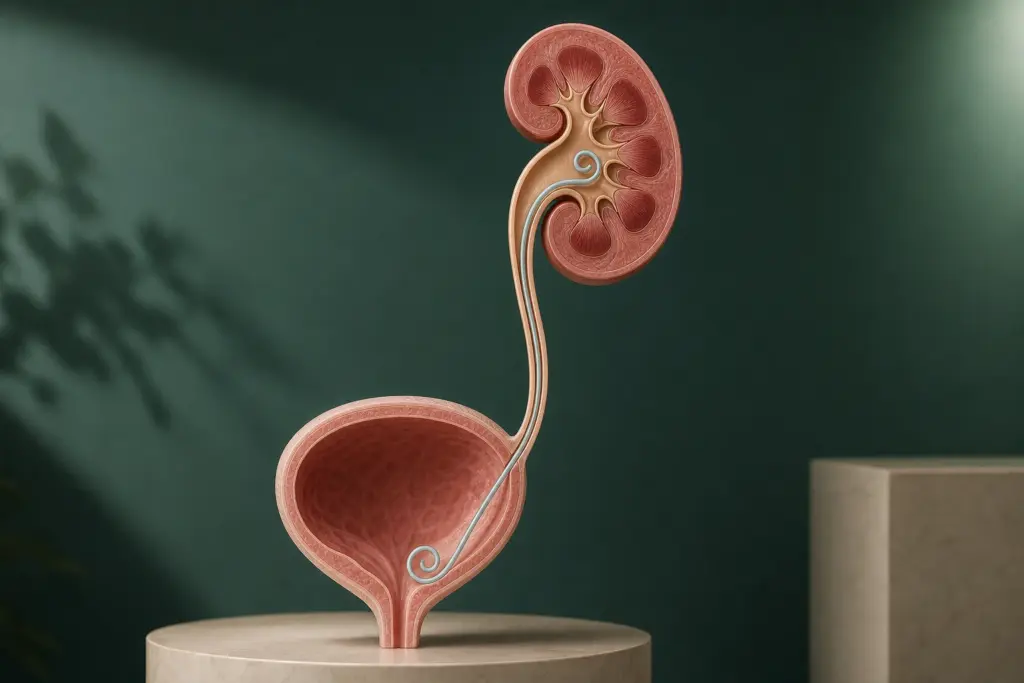
A ureteric stent is a small, flexible tube placed inside the ureter (the natural drainage tube connecting the kidney to the bladder). Its purpose is to allow urine to drain freely from the kidney to the bladder when the normal flow of urine may be blocked or the ureter needs time to heal. Although ureteric stents are commonly used, many patients are understandably concerned about what they are, why they are needed and what symptoms they may experience.
What is a ureteric stent?
A ureteric stent is a thin hollow tube, usually made from a flexible plastic material, which sits inside the ureter.
The stent has a small curl at each end:
- One end sits inside the kidney
- The other end sits inside the bladder
These curls help keep the stent securely in position. A ureteric stent does not drain urine outside the body. Instead, it keeps the natural passage between the kidney and bladder open, allowing urine to flow around and through the stent.
Why are ureteric stents used?
A ureteric stent may be recommended for several reasons, including:
When the ureter is blocked
One of the most important roles of a ureteric stent is to relieve or prevent blockage of urine drainage from the kidney. A blocked ureter can cause urine to build up in the kidney (known as hydronephrosis), which may lead to pain, infection or reduced kidney function if not treated.
A stent can help restore drainage when blockage is caused by:
- Kidney or ureteric stones
- Narrowing of the ureter (ureteric stricture)
- Swelling or inflammation of the ureter
- Compression of the ureter by nearby structures
In some situations, a ureteric stent is used as an urgent treatment to drain an obstructed kidney, particularly when there is infection or significant blockage. The underlying cause of the blockage can then be treated at a later stage.
After ureteroscopy or kidney stone treatment
Following ureteroscopy and laser treatment of a kidney or ureteric stone, a temporary ureteric stent is often inserted.
The stent may help to:
- Allow the ureter to heal after instrumentation
- Reduce the risk of blockage caused by swelling
- Maintain drainage from the kidney
- Allow small stone fragments to pass more easily
Whether a stent is required, and how long it remains in place, depends on factors such as the size and location of the stone, the complexity of the procedure and the condition of the ureter.
After other urological procedures
Ureteric stents may also be used after other procedures involving the ureter or kidney. Examples include procedures where the ureter needs support while healing or where maintaining urine drainage is important. Your surgeon will explain why a stent is recommended and how long it is expected to remain in place.
What symptoms can a ureteric stent cause?
Most patients are aware of their stent to some degree. Symptoms vary considerably between individuals and may include:
- Increased urinary frequency
- A feeling of needing to pass urine urgently
- Discomfort in the bladder or kidney area
- Stinging or burning when passing urine
- Blood in the urine, particularly after activity
These symptoms are usually due to irritation from the stent and do not necessarily mean that anything is wrong. Drinking enough fluid, avoiding constipation and taking simple pain relief when required can help manage symptoms. If symptoms are severe, persistent or associated with fever, worsening pain or feeling unwell, medical advice should be sought.
How long does a ureteric stent stay in?
The duration of stenting depends on why the stent was inserted and the individual circumstances. Some stents are required for only a few days, while others may remain for several weeks or longer.
Examples include:
- After uncomplicated ureteroscopy: often removed after a short period, depending on the procedure and findings.
- After more complex stone treatment: the stent may remain longer to allow healing and drainage.
- For ongoing blockage or ureteric problems: longer-term stenting may occasionally be required.
Your surgeon will explain why the stent is needed and when it should be removed.
How is a ureteric stent removed?
The method of removal depends on the type of stent and the reason it was inserted.
Removal during a planned second procedure
Sometimes the stent is deliberately left until a further procedure. For example, after treatment of a larger or more complex kidney stone, a stent may remain until a planned second-stage ureteroscopy.
Flexible cystoscopy removal
The most common method of planned stent removal is a short outpatient procedure called flexible cystoscopy. A small flexible camera is passed through the urethra into the bladder. The stent is gently grasped and removed.
This usually takes only a few minutes and is performed with local anaesthetic gel. Most patients find it straightforward.
Stent-on-string removal
Some stents have a thin string attached which exits through the urethra.
This allows the stent to be removed without cystoscopy. Depending on the circumstances, the string may be:
- Removed by the patient at home after receiving clear instructions
- Removed by Mr Ellis in clinic
Not every patient is suitable for a stent-on-string, and the decision depends on factors such as the type of procedure, the complexity of treatment and the risk of the stent moving prematurely.
Living with a ureteric stent
Most patients can continue normal daily activities with a stent, although symptoms may fluctuate.
Helpful measures include:
- Drinking enough fluid to keep urine flowing comfortably
- Avoiding activities that significantly worsen discomfort
- Taking prescribed medication if required
- Following instructions regarding removal timing
Exercise, work and travel are usually possible, but individual advice depends on your procedure and recovery.
Frequently asked questions about ureteric stents
Is a ureteric stent painful?
The stent itself is not usually painful, but it can cause bladder irritation and discomfort in the kidney or bladder area. Symptoms often settle once the stent is removed.
Can I feel the stent inside me?
You cannot usually feel the stent itself, but you may notice urinary symptoms caused by irritation of the bladder or ureter.
Is blood in the urine normal with a stent?
Yes. Some blood in the urine is common, particularly after physical activity. However, heavy bleeding, clots, fever or worsening symptoms should be assessed.
What happens if a stent is not removed?
A ureteric stent should only remain in place for the period recommended by your urologist. Failure to remove a stent at the appropriate time can lead to complications, including encrustation and difficulty with removal.
Can I have a stent removed without another operation?
Yes. Many stents can be removed as a short outpatient procedure using flexible cystoscopy, or in selected cases using a stent-on-string.
Ureteric stents at a glance
| Purpose | Keeps the kidney draining into the bladder |
|---|---|
| Used for | Kidney stones, ureteric blockage and after some urological procedures |
| Insertion | Usually performed during a procedure under anaesthetic |
| Removal | Flexible cystoscopy, stent-on-string or during a planned procedure |
| Common symptoms | Frequency, urgency, discomfort and blood in urine |
| Duration | Depends on the reason for insertion |
Arrange a consultation
If you have been advised that you need a ureteric stent, or are experiencing problems with a stent following kidney stone treatment, Mr Gidon Ellis offers specialist assessment and treatment in London. A consultation provides an opportunity to understand why the stent is needed, what to expect and how your ongoing treatment will be managed.