

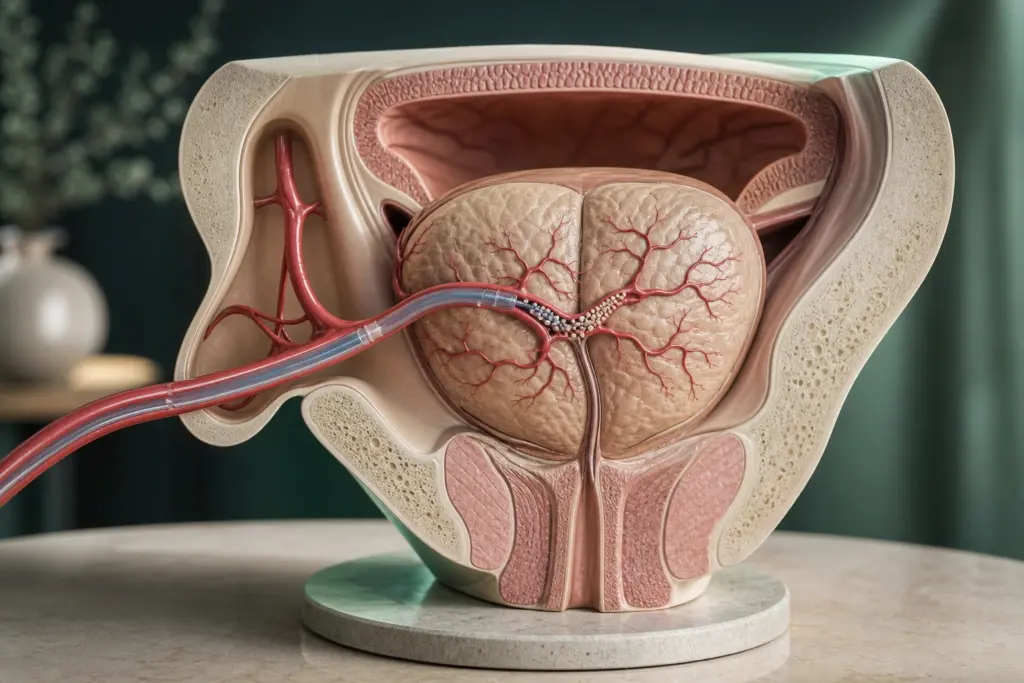
A minimally invasive treatment option for selected men with prostate enlargement
Prostatic artery embolisation (PAE) is a minimally invasive treatment for men with an enlarged prostate causing lower urinary tract symptoms (LUTS). Unlike surgical treatments such as HoLEP, Aquablation or TURP, PAE does not require a general anaesthetic, does not involve passing instruments through the urinary passage and does not remove prostate tissue.
Instead, tiny particles are injected into the blood vessels supplying the prostate. This reduces blood flow to targeted areas of prostate tissue, leading to gradual reduction in prostate volume and improvement in urinary symptoms.
PAE is performed by specialist interventional radiologists. Mr Gidon Ellis does not perform PAE himself but works closely with experienced colleagues and can advise whether this option may be appropriate as part of an individualised treatment plan.
What is an enlarged prostate?
The prostate naturally enlarges as men age. In some men, this enlargement can compress the urethra and obstruct urine flow, leading to symptoms such as:
- Weak urinary stream
- Difficulty starting urination
- Straining to pass urine
- A feeling of incomplete bladder emptying
- Frequent or urgent urination
This condition is known as benign prostatic hyperplasia (BPH).
What is PAE?
PAE is a non-surgical treatment that reduces the blood supply to the prostate.
During the procedure:
- A thin tube (catheter) is passed into an artery, usually through the wrist or groin.
- The blood vessels supplying the prostate are identified using X-ray guidance.
- Tiny particles are injected to reduce blood flow to targeted areas of prostate tissue.
- The prostate gradually reduces in volume over the following months.
Because there is no cutting or removal of prostate tissue, recovery is usually quicker than traditional surgery.
Why patients choose PAE
Potential advantages of PAE include:
- Usually performed without a general anaesthetic
- No surgery through the urinary passage
- No removal of prostate tissue
- Short recovery period
- Lower risk of ejaculatory problems compared with many prostate operations
- An option for some men who wish to avoid surgery
Who is suitable for PAE?
PAE may be considered for men with:
- Symptoms caused by an enlarged prostate
- Prostate enlargement confirmed on imaging
- A preference to avoid surgical treatment
- Symptoms that have not improved sufficiently with medication
However, careful assessment is important because urinary symptoms can have multiple causes, including bladder dysfunction or causes unrelated to prostate enlargement.
Assessment before PAE
Before proceeding with PAE, patients typically undergo a detailed assessment to confirm that the treatment is likely to be suitable.
This usually includes:
- A review with an interventional radiologist who performs PAE
- A planning CT angiogram to assess the blood vessels supplying the prostate and determine whether the anatomy is suitable for treatment
- Discussion of the expected benefits, limitations and potential risks of the procedure
This assessment allows the interventional radiologist to confirm technical suitability and provide more personalised counselling based on your individual prostate anatomy, symptoms and treatment goals.
PAE may be less suitable for men with:
- Significant bladder outlet obstruction requiring immediate relief
- Severe urinary retention
- Certain prostate anatomies or vascular patterns
- Significant bladder dysfunction
A detailed assessment helps determine whether PAE or another treatment would provide the best long-term outcome.
Recovery after PAE
PAE is usually performed as a day-case procedure. Most patients return home the same day.
After treatment, some men experience temporary symptoms including:
- Pelvic discomfort
- Increased urinary frequency or urgency
- Burning when passing urine
- A small amount of blood in the urine
These symptoms usually settle over days to weeks. Unlike procedures such as HoLEP, improvement after PAE is gradual. Symptom improvement typically occurs over several weeks to months as the prostate reduces in volume.
How effective is PAE?
PAE can provide significant improvement in urinary symptoms and quality of life for appropriately selected patients. However, the degree of improvement can vary between individuals. Compared with tissue-removing procedures such as HoLEP or TURP, symptom improvement after PAE may be less predictable and some patients may require additional treatment in the future.
The most appropriate treatment depends on factors including:
- Prostate size and anatomy
- Bladder function
- Severity of symptoms
- Previous treatments
- Personal priorities
PAE compared with other prostate treatments
There is no single “best” treatment for every man with BPH.
Different procedures have different advantages:
- PAE: minimally invasive, performed by interventional radiologists, avoids surgery through the urinary passage
- UroLift: implant-based treatment designed to preserve ejaculation in selected prostate anatomies
- Aquablation: robotic waterjet treatment removing obstructing prostate tissue while aiming to preserve sexual function
- HoLEP: laser removal of prostate tissue, highly durable and suitable for prostates of almost any size
- TURP: established surgical treatment removing obstructing prostate tissue
The right choice depends on your prostate anatomy, bladder function, symptom severity and personal priorities.
PAE at a glance
| Full name | Prostatic artery embolisation |
|---|---|
| Treats | Enlarged prostate causing urinary symptoms |
| Technique | Reduces prostate blood supply using tiny particles |
| Performed by | Interventional radiologist |
| Anaesthetic | Usually local anaesthetic with sedation |
| Hospital stay | Usually day case |
| Recovery | Days to weeks, with gradual symptom improvement |
Frequently asked questions
Do you perform PAE?
No. PAE is performed by specialist interventional radiologists rather than urologists. Mr Ellis provides independent advice regarding all available prostate treatments and can refer suitable patients to experienced colleagues who perform PAE.
Is PAE better than HoLEP?
Not necessarily. Both treatments have advantages and limitations. HoLEP removes the obstructing prostate tissue directly and provides very durable symptom relief. PAE avoids surgery and may be attractive for selected patients who wish to avoid an operation.
The best treatment depends on your prostate, bladder function, symptoms and personal preferences.
Does PAE affect ejaculation?
PAE generally has a lower risk of ejaculatory problems compared with many surgical treatments. However, individual outcomes vary.
How quickly does PAE work?
Unlike treatments that immediately remove prostate tissue, PAE works gradually. Improvement usually occurs over weeks to months.
Why choose Mr Ellis?
The best prostate treatment is not simply the newest or least invasive option — it is the option that best matches your anatomy, symptoms and priorities. Mr Ellis provides specialist assessment of men with LUTS and enlarged prostate, offering impartial advice across the full range of treatments, including referral for PAE where appropriate.
Arrange a consultation
If you are considering treatment for an enlarged prostate and would like to understand your options, Mr Gidon Ellis can provide specialist assessment and discuss the most appropriate pathway for you.