

A minimally invasive treatment designed to improve urinary symptoms while preserving ejaculation
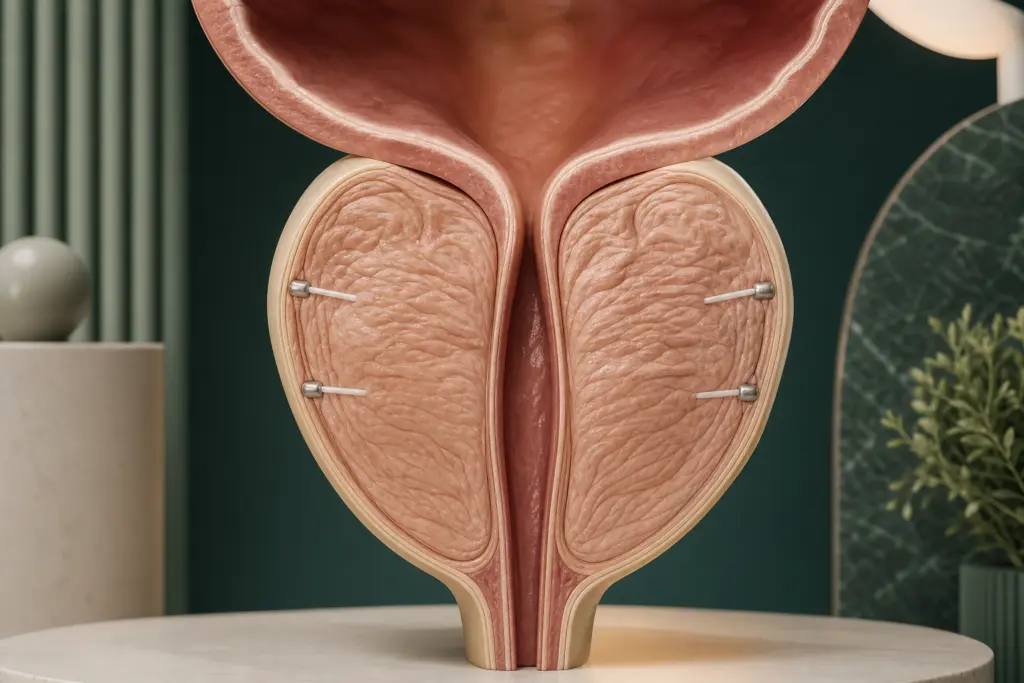
UroLift® is a minimally invasive treatment for men with an enlarged prostate causing lower urinary tract symptoms (LUTS). Unlike traditional prostate surgery, UroLift does not remove prostate tissue. Instead, small implants are used to gently lift and hold the enlarged prostate tissue away from the urinary channel, improving the flow of urine.
A key advantage of UroLift is that it is designed to relieve obstruction while preserving sexual function, particularly ejaculation, which is an important consideration for many men. Mr Gidon Ellis offers a comprehensive range of treatments for enlarged prostate, helping patients choose the option that best matches their prostate anatomy, symptoms and personal priorities.
What is UroLift?
UroLift (prostatic urethral lift) is a procedure that uses small permanent implants to hold the enlarged prostate away from the urethra. The aim is to widen the urinary channel and reduce the blockage caused by benign prostatic hyperplasia (BPH). Unlike procedures such as HoLEP and TURP, UroLift does not involve cutting or removing prostate tissue.
How is UroLift performed?
UroLift is performed as a day-case procedure, usually under general anaesthetic, using a small telescope passed through the natural urinary passage.
During the procedure:
- The prostate is assessed using a telescope.
- Small implants are placed through the prostate tissue.
- The implants pull the prostate lobes apart, opening the urethral channel.
- No prostate tissue is removed.
The procedure usually takes less than an hour, and patients are usually able to go home the same day.
Why patients choose UroLift
Potential advantages of UroLift include:
- Minimally invasive treatment
- No cutting or removal of prostate tissue
- Usually rapid recovery
- Low risk of sexual side effects, particularly preservation of ejaculation
- Can often be performed as a day-case procedure
- Suitable for selected men who wish to avoid more invasive surgery
Who is suitable for UroLift?
UroLift is not suitable for every man with an enlarged prostate.
The best candidates are usually men with:
- Mild to moderate bladder outlet obstruction due to BPH
- A prostate size within the recommended range for the technique
- Prostate anatomy suitable for implant placement
- A priority to preserve ejaculation
Some prostate anatomies, particularly significant obstruction caused by an enlarged median lobe, may make UroLift less suitable. A detailed assessment of prostate size and shape is important before deciding whether UroLift is the right option.
Recovery after UroLift
Most patients return home on the same day.
Some men experience temporary symptoms after treatment, including:
- Burning when passing urine
- Increased urinary frequency or urgency
- Mild pelvic discomfort
- A small amount of blood in the urine
These symptoms usually improve over days to weeks. Urinary improvement is often gradual as the prostate settles around the implants.
How effective is UroLift?
UroLift can provide meaningful improvement in urinary symptoms for appropriately selected patients. Studies have demonstrated improvements in urinary symptoms and quality of life, while maintaining a lower risk of sexual side effects compared with some tissue-removing procedures.
However, because UroLift does not remove prostate tissue, some men may experience recurrence of symptoms over time and require additional treatment. The likelihood of needing further treatment depends on factors including prostate size, anatomy and individual response.
Considerations before choosing UroLift
UroLift is an excellent option for selected men with an enlarged prostate, particularly those who prioritise preservation of ejaculation and a rapid recovery. However, like all treatments, it has limitations that should be considered when comparing treatment options.
Not suitable for every prostate anatomy
UroLift works by mechanically holding prostate tissue away from the urinary channel rather than removing it.
For this reason, it may not be suitable for some men, particularly those with:
- Significant obstruction from an enlarged median lobe
- Very large prostates
- Complex bladder outlet obstruction
A detailed assessment of prostate size and shape is important before deciding whether UroLift is appropriate.
Improvement may be more gradual
Unlike procedures that remove obstructing prostate tissue, UroLift does not immediately create a larger channel by removing tissue. Some men notice improvement quickly, but symptoms may continue to improve gradually over several weeks or months.
Possibility of needing further treatment
Because UroLift does not remove prostate tissue, some men may experience recurrence of urinary symptoms over time. The chance of needing additional treatment in the future is higher than with some tissue-removing procedures, such as HoLEP or TURP. This is an important consideration when choosing between treatments, particularly for younger men who may require many years of symptom control.
Pelvic discomfort and urinary irritation
Some men experience temporary pelvic discomfort, perineal discomfort or urinary irritation following UroLift. Symptoms such as urinary frequency, urgency, burning or a small amount of blood in the urine are usually temporary and improve as healing takes place. Persistent discomfort is uncommon but should be discussed as part of informed decision-making.
Future MRI scans
UroLift implants are designed to be compatible with MRI scanning under specified conditions. However, the implants can create artefact on MRI images around the prostate, which may occasionally make interpretation more challenging. It is important to inform your doctor and radiology team that you have UroLift implants if you undergo future prostate imaging, particularly multiparametric MRI used in the assessment of prostate cancer.
UroLift compared with other prostate treatments
There is no single “best” treatment for every man with BPH.
Different procedures have different strengths:
- UroLift: minimally invasive, designed to preserve ejaculation, suitable for selected prostate anatomy
- Aquablation: tissue-removing treatment using robotic waterjet technology, suitable for a broad range of prostate sizes with a focus on preserving sexual function
- HoLEP: laser removal of obstructing prostate tissue, highly durable and suitable for prostates of almost any size
- TURP: established surgical treatment removing obstructing prostate tissue
The best choice depends on prostate size, anatomy, symptom severity, bladder function and personal priorities.
UroLift at a glance
| Full name | Prostatic urethral lift (UroLift) |
|---|---|
| Treats | Enlarged prostate causing urinary obstruction |
| Technique | Small implants widen the prostate channel without removing tissue |
| Anaesthetic | Usually general anaesthetic |
| Hospital stay | Usually day case |
| Recovery | Usually days to a few weeks |
| Main advantage | Preservation of ejaculation in many patients |
Frequently asked questions
Does UroLift remove the prostate?
No. UroLift does not remove prostate tissue. Small implants are placed to hold prostate tissue away from the urinary channel.
Will UroLift affect ejaculation?
One of the main advantages of UroLift is that it has a low risk of ejaculatory dysfunction compared with many traditional prostate operations.
Is UroLift suitable for a very large prostate?
Usually not. Other treatments, such as HoLEP, may be more appropriate for significantly enlarged prostates.
How long do UroLift implants last?
The implants are designed to remain permanently in place. However, symptoms can recur over time in some patients, and further treatment may occasionally be required.
Why choose Mr Ellis?
Choosing the right treatment for an enlarged prostate requires careful assessment of prostate anatomy, bladder function and personal priorities. Mr Ellis offers a full range of BPH treatments, from medication through to minimally invasive and surgical options, allowing treatment recommendations to be tailored to each individual patient.
Arrange a consultation
If you are experiencing urinary symptoms due to an enlarged prostate and would like to understand your treatment options, Mr Gidon Ellis can provide specialist assessment and discuss which approach is most suitable for you.