

A heat-free, image-guided treatment for benign prostatic enlargement
Mr Gidon Ellis is a Consultant Urological Surgeon in London specialising in the treatment of benign prostatic hyperplasia (BPH), including minimally invasive surgical treatments such as Aquablation.
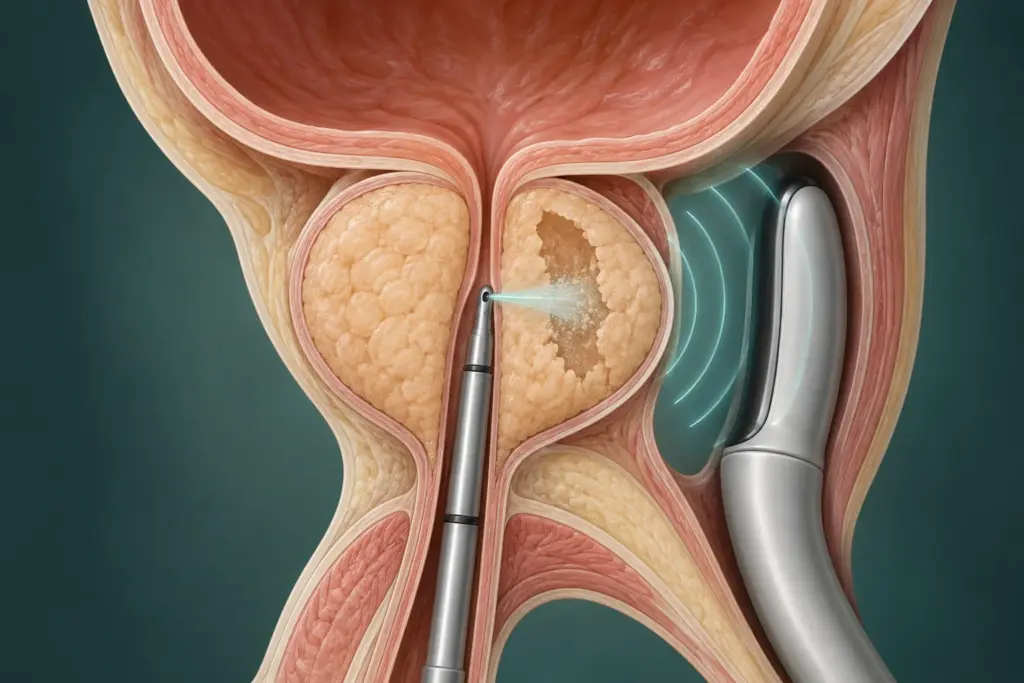
Aquablation is a treatment for men with urinary symptoms caused by an enlarged prostate. It uses a robotically controlled high-pressure waterjet to remove obstructing prostate tissue, without using heat energy. The procedure combines detailed ultrasound imaging with computer-guided planning to help precisely target the areas of the prostate responsible for urinary obstruction.
What is Aquablation?
Aquablation is a minimally invasive procedure used to treat benign prostatic hyperplasia (BPH), the non-cancerous enlargement of the prostate that can cause difficulty passing urine. During Aquablation, a small instrument is passed through the urethra (the natural urinary passage). Ultrasound imaging is used to create a detailed map of the prostate, allowing the surgeon to plan the treatment area. A robotically controlled waterjet is then used to remove the obstructing prostate tissue.
Unlike traditional prostate surgery, Aquablation does not use heat energy to remove tissue. This may help reduce injury to surrounding structures and is one reason the procedure has attracted interest from men who wish to prioritise preservation of sexual function.
Who can benefit from Aquablation?
Aquablation may be suitable for men with bothersome urinary symptoms caused by an enlarged prostate, particularly those who have not achieved sufficient improvement with medication. Symptoms that may improve include:
- A weak urinary stream
- Difficulty starting urination
- Straining to pass urine
- A feeling of incomplete bladder emptying
- Frequent urination
- Waking at night to pass urine (nocturia)
- Urgency
- Urinary retention related to prostate obstruction
Aquablation can be considered for a broad range of prostate sizes, including larger prostates, although the most appropriate treatment depends on individual anatomy, symptoms and priorities.
What are the advantages of Aquablation?
Heat-free treatment
Aquablation uses a waterjet rather than heat energy to remove prostate tissue. This is an important distinction from many other surgical approaches.
Image-guided precision
The procedure uses real-time ultrasound imaging and computer-assisted planning to help accurately identify and treat the obstructing prostate tissue.
Consideration of sexual function
One of the main reasons men consider Aquablation is its favourable profile regarding ejaculation compared with some traditional prostate operations. However, as with all prostate procedures, side effects can occur and preservation of ejaculation cannot be guaranteed. These risks should be discussed as part of an individual treatment decision.
Effective relief from urinary obstruction
Clinical studies have demonstrated that Aquablation can provide significant improvements in urinary symptoms and urine flow for men with BPH.
Recovery after Aquablation
Most patients stay in hospital for at least one night following Aquablation. A urinary catheter is usually removed within one to two days, although this depends on factors such as prostate size, bleeding risk and individual recovery.
Many men notice improvement in their urinary stream soon after treatment. During the first few weeks, some patients experience urinary frequency, urgency, burning or intermittent blood in the urine as the prostate heals.
Most men return to desk-based work within one to two weeks, although recovery varies between individuals. Mr Ellis will review your progress after surgery and ensure that your recovery and urinary improvement are progressing as expected.
Aquablation or HoLEP: which is right for me?
Aquablation and HoLEP are both effective, minimally invasive options for treating an enlarged prostate, and the right choice depends on your individual circumstances rather than one being universally superior.
- Aquablation uses a heat-free waterjet with image-guided planning, has a comparatively short operating time regardless of prostate size, and is often considered by men particularly focused on preserving ejaculatory function.
- HoLEP uses a laser to enucleate prostate tissue, is highly effective across the full range of prostate sizes including very large glands, and has a long track record with very low rates of symptoms returning.
Both procedures typically require a short hospital stay and a temporary catheter. Mr Ellis will discuss your prostate size, symptoms, priorities and any relevant medical history to help you decide which approach is right for you.
What are the risks of Aquablation?
As with any prostate procedure, Aquablation carries some risks, which Mr Ellis will discuss with you in detail. These can include:
- Bleeding, occasionally requiring a return to theatre or transfusion
- Infection
- Temporary urinary symptoms such as urgency, frequency or burning
- Retrograde ejaculation (semen entering the bladder rather than leaving the body during ejaculation)
- A small risk of urinary incontinence
- The need for further treatment if symptoms do not fully resolve