

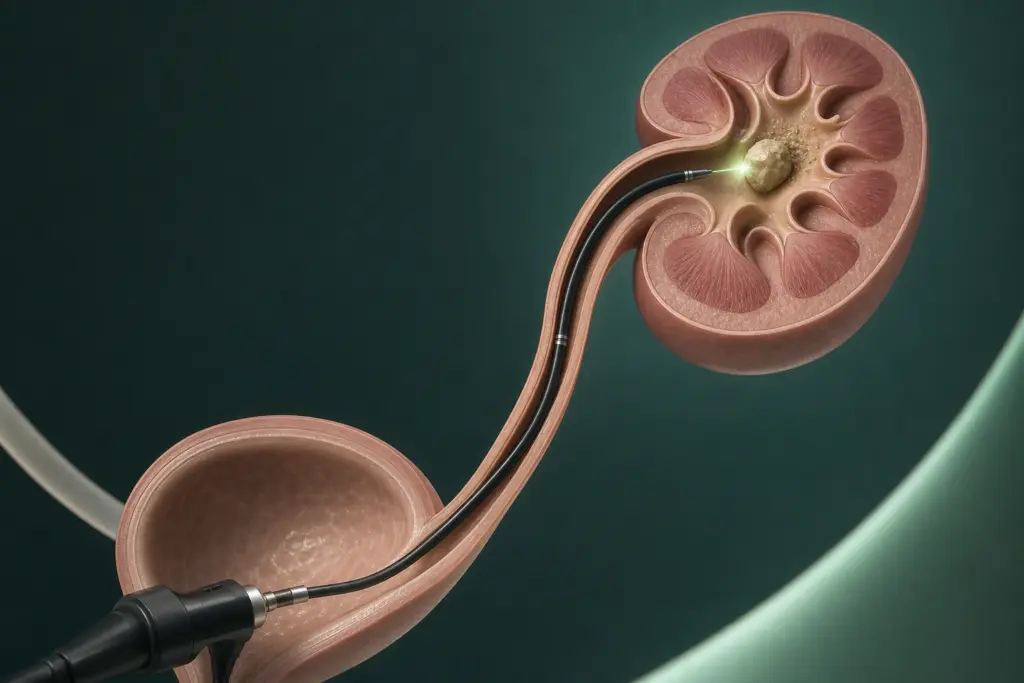
Ureteroscopy (URS) for kidney and ureteric stones
Mr Gidon Ellis is a Consultant Urological Surgeon in London specialising in the minimally invasive treatment of kidney and ureteric stones, including ureteroscopy, laser stone fragmentation and other endourological procedures.
Ureteroscopy is a minimally invasive procedure used to diagnose and treat stones within the ureter and kidney. It uses a fine telescope passed through the natural urinary passage to directly access the stone, without any cuts to the skin. Modern ureteroscopy, particularly flexible ureteroscopy using laser technology, has become one of the most effective treatments for many kidney and ureteric stones.
What is ureteroscopy?
Ureteroscopy involves passing a narrow telescope (called a ureteroscope) through the urethra and bladder, then into the ureter and kidney. The ureteroscope allows the surgeon to directly see the stone. A laser fibre is then used to fragment the stone into smaller pieces, which can either be removed using a small basket or allowed to pass naturally.
There are two main types of ureteroscopy:
- Rigid ureteroscopy – commonly used for stones in the ureter.
- Flexible ureteroscopy – uses a highly manoeuvrable instrument that can access many areas within the kidney.
Because the procedure is performed through the urinary tract, there are no external cuts or incisions.
Who can benefit from ureteroscopy?
Ureteroscopy may be recommended for patients with kidney or ureteric stones when:
- The stone is unlikely to pass naturally
- The stone is causing pain or blockage
- Shockwave lithotripsy (SWL/ESWL) has not been successful or is unlikely to be effective
- A rapid stone clearance is required
- The stone is in a location that is difficult to treat with other methods
Ureteroscopy can treat stones in many different locations and is suitable for a wide range of stone sizes, although the most appropriate treatment depends on the individual stone characteristics.
What are the advantages of ureteroscopy?
Direct treatment of the stone
Unlike shockwave treatment, which breaks stones from outside the body, ureteroscopy allows the surgeon to directly visualise and treat the stone.
No external cuts
The procedure is performed through the natural urinary passage, avoiding skin incisions and allowing a relatively rapid recovery.
Effective stone clearance
Modern ureteroscopy with laser fragmentation provides excellent stone clearance rates for appropriately selected patients, particularly for ureteric stones and many kidney stones.
Can treat complex stones
Flexible ureteroscopy allows access to many areas of the kidney and can be used when other treatments may be less suitable.
Allows diagnosis as well as treatment
Ureteroscopy can also be used to inspect the lining of the ureter and kidney. In selected cases, biopsies can be taken if an abnormal area requires further assessment.
Recovery after ureteroscopy
Most ureteroscopic stone procedures are performed as day-case surgery, although some patients may require an overnight stay depending on the complexity of the procedure and individual circumstances. It is common to experience:
- Mild burning or stinging when passing urine
- Increased urinary frequency or urgency
- A small amount of blood in the urine
These symptoms usually improve over the following days. A temporary ureteric stent is often placed after ureteroscopy to allow the kidney to drain and the ureter to heal. Stent symptoms can include urinary frequency, discomfort in the kidney or bladder area, and blood in the urine. The stent is usually removed after a short period, often within one to two weeks, depending on the circumstances.
Mr Ellis will arrange appropriate follow-up to confirm stone clearance and discuss strategies to reduce the risk of future stones.
Ureteroscopy, shockwave treatment or PCNL: which is right for you?
There is no single best treatment for every kidney stone – the right approach depends on the size, location and composition of the stone, as well as your anatomy and preferences.
- ESWL is non-invasive and avoids any instruments entering the urinary tract, but is best suited to smaller, favourably positioned stones and may need more than one session.
- Ureteroscopy allows the stone to be directly visualised and treated in a single procedure in most cases, and is often preferred for stones that have not cleared with ESWL, or that are in a location better reached with a telescope.
- PCNL is generally reserved for larger stones within the kidney, where a more direct surgical approach through the skin achieves faster and more complete clearance.
Mr Ellis will discuss the options relevant to your specific stone and help you choose the treatment best suited to your circumstances.