

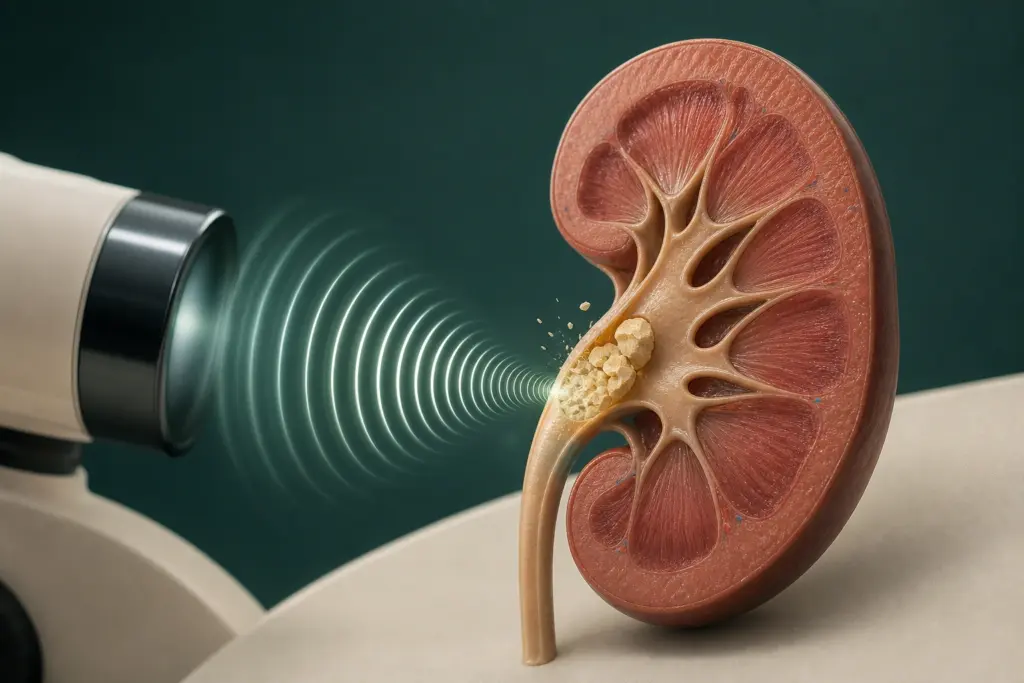
Non-invasive shockwave treatment for suitable kidney stones
Mr Gidon Ellis is a Consultant Urological Surgeon in London specialising in the diagnosis and treatment of kidney and ureteric stones, including shockwave lithotripsy (ESWL), ureteroscopy and other minimally invasive stone treatments.
Extracorporeal Shock Wave Lithotripsy (ESWL) is a non-invasive treatment that uses focused shock waves to break kidney stones into smaller fragments, allowing them to pass naturally through the urinary tract. Unlike ureteroscopy, ESWL is not a surgical procedure. It does not involve passing instruments into the urinary tract and does not require any cuts or incisions.
What is ESWL?
During ESWL, focused shock waves are delivered from outside the body and targeted at the kidney stone using X-ray or ultrasound imaging. The energy from the shock waves gradually breaks the stone into smaller pieces. These fragments can then pass naturally through the urinary tract over the following days or weeks.
ESWL is performed in a dedicated lithotripsy treatment suite rather than an operating theatre. The procedure is usually carried out by a specialist lithotripsy practitioner or sonographer, with appropriate medical support and urological oversight. No general anaesthetic is normally required. Most patients receive pain relief before and during treatment, and the procedure is performed as an outpatient appointment.
Who can benefit from ESWL?
ESWL is suitable for many patients with kidney stones, particularly when the stone is visible on imaging and is in a favourable position for treatment. It is most commonly used for:
Stones within the kidney
Stones in the upper ureter
Smaller stones where spontaneous passage is unlikely or symptoms persist
Patients who wish to avoid an invasive procedure
The success of ESWL depends on several factors, including:
Stone size
Stone location
Stone composition and density
Anatomy of the kidney and urinary tract
Patient factors such as body habitus
Some stones may require more than one ESWL treatment session, and some stones are better treated using ureteroscopy or PCNL.
What are the advantages of ESWL?
No surgery or instruments inside the urinary tract
ESWL treats the stone from outside the body, avoiding the need for a telescope or surgical instruments to enter the urinary tract.
No cuts or incisions
Because ESWL is performed externally, there are no surgical wounds and recovery is usually rapid.
No general anaesthetic required
Most patients undergo ESWL with pain relief alone, avoiding the need for a general anaesthetic.
Outpatient treatment
Patients attend the lithotripsy suite for treatment and usually return home shortly afterwards.
Short treatment time
A typical ESWL session takes around 30–60 minutes, depending on the stone and treatment requirements.
Established treatment option
ESWL has been used successfully for many decades and remains an important treatment option for appropriately selected kidney stones.
What happens during ESWL?
Before treatment, imaging is used to confirm the location of the stone and plan the procedure. During ESWL:
- You will lie on a treatment table with the stone positioned using X-ray or ultrasound guidance.
- Shock waves are focused onto the stone.
- The stone is gradually fragmented into smaller pieces.
- You can usually go home shortly afterwards.
Pain relief is provided before and during treatment. The level of discomfort varies between patients, but most people tolerate the procedure well.
Recovery after ESWL
Most patients return home shortly after the procedure and can resume normal activities within a short period. As the stone fragments pass, it is common to experience:
- Mild discomfort or colicky pain
- Blood in the urine
- Increased urinary frequency or urgency
These symptoms usually settle over a few days as the fragments pass, and simple pain relief is often all that is needed. Drinking plenty of fluids can help the fragments pass more easily. You should contact Mr Ellis or seek urgent medical advice if you develop fever, severe pain that is not controlled with pain relief, or difficulty passing urine.
Follow-up imaging is usually arranged after treatment to confirm the stone has fragmented and passed successfully. If significant fragments remain, a further session of ESWL or an alternative treatment such as ureteroscopy may be recommended.
What are the risks of ESWL?
ESWL is generally very safe, but as with any treatment there are some possible risks and limitations, including:
- Not all stones fragment successfully with ESWL
- Some stones require more than one treatment session
- Fragments may occasionally cause temporary blockage of the ureter, requiring further treatment
- Mild bruising of the skin over the treatment area can occur
- Blood in the urine for a few days is common and usually settles on its own
Mr Ellis will discuss whether ESWL is the most suitable option for your particular stone, or whether an alternative treatment such as ureteroscopy or PCNL would be more effective.