

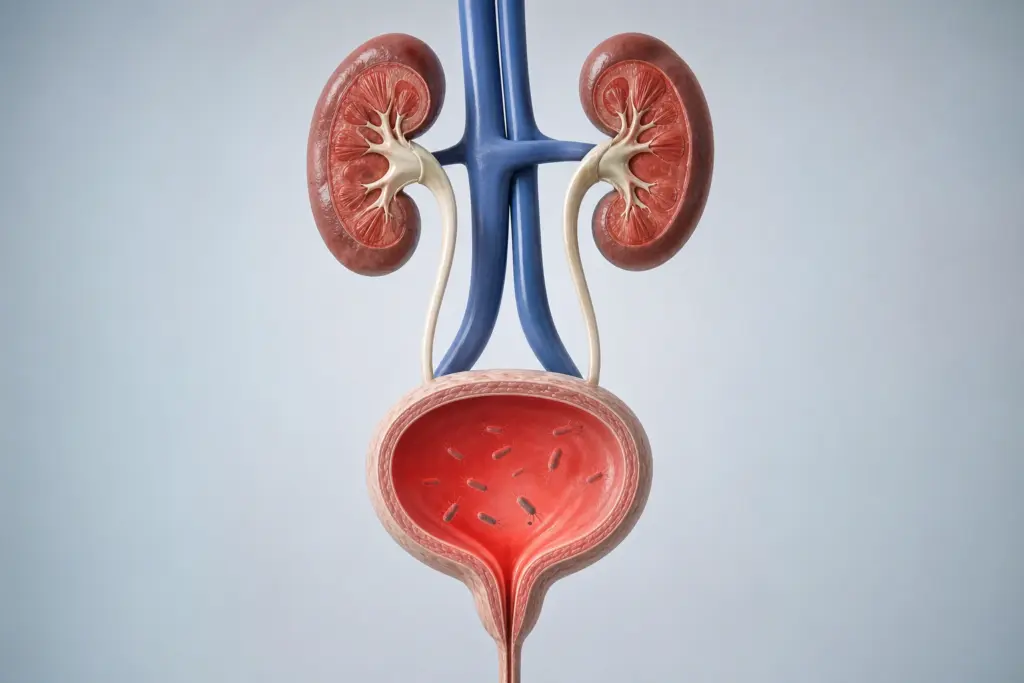
Upper tract urothelial cancer is a cancer that develops in the lining of the renal pelvis or ureter – the parts of the urinary tract that carry urine from the kidneys to the bladder. It is less common than bladder cancer but belongs to the same family of cancers because both usually arise from urothelial cells.
The most common warning sign is blood in the urine (haematuria). Upper tract urothelial cancer can sometimes be difficult to diagnose because its symptoms may be similar to those caused by urinary tract infections, kidney stones or other urinary conditions. Early specialist assessment is important because treatment depends on the location, size and characteristics of the tumour and whether there is evidence that it has spread.
What is upper tract urothelial cancer?
The urinary tract is lined by specialised cells called urothelial cells.
These cells line:
- The renal pelvis – the part of the kidney where urine collects before entering the ureter
- The ureters – the tubes carrying urine from the kidneys to the bladder
- The bladder
Cancer arising from these cells in the renal pelvis or ureter is called upper tract urothelial carcinoma (UTUC). Upper tract urothelial cancer can occur in one kidney or ureter, or occasionally affect both sides.
What are the symptoms?
The most common symptom is blood in the urine (haematuria).
This may be:
- Visible blood in the urine
- Blood detected only on urine testing
- Blood that appears intermittently and then disappears
Other possible symptoms include:
- Pain in the side or back (loin pain)
- Recurrent urinary tract infections
- Urinary frequency or urgency
- Unexplained weight loss
- Occasionally, difficulty with urine drainage if the tumour obstructs the ureter
Some patients have no symptoms and the tumour is discovered during investigation for another reason.
Related: Blood in the Urine (Haematuria)
What increases the risk?
Several factors are associated with an increased risk of upper tract urothelial cancer.
Age
The risk increases with age, although upper tract urothelial cancer can occur in younger adults.
Smoking
Smoking is an important risk factor for urothelial cancers. Harmful chemicals from tobacco are absorbed into the bloodstream, filtered by the kidneys and concentrated in the urine, where they can come into contact with the urothelial lining.
Previous urothelial cancer
People who have previously had bladder cancer or another urothelial cancer have an increased risk of developing tumours elsewhere in the urinary tract.
Family history and inherited conditions
A small proportion of upper tract urothelial cancers are associated with inherited conditions, particularly Lynch syndrome. A family history of certain cancers may therefore be relevant when assessing an individual’s risk.
How is upper tract urothelial cancer diagnosed?
Investigation usually involves a combination of imaging, urine tests and, in selected cases, direct examination of the upper urinary tract.
CT urogram
A CT urogram is an important investigation when upper tract urothelial cancer is suspected. It provides detailed images of the kidneys, renal pelvis and ureters and can identify abnormalities affecting the urinary tract.
Urine tests
Urine may be examined for blood and, in selected circumstances, abnormal urothelial cells. Urine cytology can sometimes provide useful information, particularly when a high-grade urothelial cancer is suspected.
Cystoscopy
Because urothelial cancer can affect different parts of the urinary tract, cystoscopy is often performed to examine the bladder and exclude a bladder tumour.
Ureteroscopy
In selected patients, ureteroscopy is a minimally invasive surgical procedure performed under general anaesthetic. A small telescope is passed through the bladder and into the ureter and renal pelvis, allowing the urinary tract lining to be examined directly.
If a suspicious area is identified, a biopsy may be taken for laboratory analysis. In selected cases, small tumours may also be treated during the same procedure using specialised instruments or laser energy.
Ureteroscopy is not required in every patient. It is considered when imaging and urine tests do not provide enough information to establish the nature of an abnormality or when direct assessment or treatment is required.
How is upper tract urothelial cancer treated?
Treatment depends on several factors, including:
- The location of the tumour
- Its size and appearance
- Whether it is thought to be low or high risk
- Whether there is evidence of invasion or spread
- The function of the opposite kidney
- The patient’s overall health and preferences
Endoscopic treatment
Selected small, localised tumours may be suitable for kidney-sparing endoscopic treatment using ureteroscopy. Ureteroscopy is a minimally invasive surgical procedure performed under general anaesthetic. A small telescope is passed through the urinary tract into the ureter or kidney, allowing the tumour to be directly visualised and, where appropriate, treated using specialised instruments or laser energy.
This approach can preserve the kidney and may be appropriate in carefully selected patients. Because there is a risk of recurrence, patients treated endoscopically require close surveillance.
Surgery
For patients with higher-risk disease, extensive or invasive tumours, or tumours that are not suitable for endoscopic management, removal of the kidney and ureter may be recommended. This operation is known as radical nephroureterectomy. The exact approach depends on the location and characteristics of the tumour and the patient’s overall health.
Systemic treatment
Some patients may require treatment with systemic therapies such as chemotherapy or immunotherapy. These treatments may be used before or after surgery or for more advanced disease, depending on the individual circumstances. Treatment decisions are usually made through a specialist multidisciplinary team (MDT) involving urologists, oncologists, radiologists, pathologists and other specialists.
Can upper tract urothelial cancer be treated without removing the kidney?
Sometimes. One of the important considerations when treating upper tract urothelial cancer is balancing cancer control with preservation of kidney function. Selected patients with smaller or apparently lower-risk tumours may be suitable for kidney-sparing endoscopic treatment.
However, kidney-sparing treatment is not appropriate for every tumour. The risk of recurrence or progression must be carefully weighed against the benefits of preserving the kidney.
What happens after treatment?
Upper tract urothelial cancer can recur, either in the same area or elsewhere within the urinary tract. For this reason, ongoing surveillance is important.
Follow-up may include:
- Cystoscopy
- Urine cytology
- CT or other imaging
- Repeat ureteroscopy in selected patients
- Further treatment where necessary
The exact surveillance programme depends on the original tumour and the treatment provided.
When should I seek medical advice?
Blood in the urine should always be assessed, even if it occurs only once, is painless or subsequently disappears.
You should seek medical advice if you notice:
- Visible blood in your urine
- Repeated unexplained blood detected on urine testing
- Unexplained loin or abdominal pain
- Recurrent urinary tract infections
- Persistent or unexplained urinary symptoms
There are many possible causes of these symptoms, most of which are not cancer. However, upper tract urothelial cancer is one of the conditions that may need to be excluded.
Frequently asked questions
Is upper tract urothelial cancer the same as bladder cancer?
They are different cancers based on their location, but they usually arise from the same type of cell — the urothelial cell. Bladder cancer develops in the bladder, while upper tract urothelial cancer develops in the renal pelvis or ureter.
Is upper tract urothelial cancer serious?
It can be. Some tumours are small and low risk and can be treated while preserving the kidney. Others can be more aggressive and require major surgery or systemic treatment. The outlook depends on the tumour’s grade, stage and other characteristics.
Can kidney stones cause upper tract urothelial cancer?
Kidney stones do not usually cause upper tract urothelial cancer. However, stones can cause blood in the urine and other symptoms that overlap with those of upper tract tumours. Persistent or unexplained haematuria therefore sometimes requires investigation even when a patient has a known history of stones.
Can upper tract urothelial cancer be seen on an ultrasound?
Ultrasound can identify some abnormalities within the kidneys and urinary tract, but it cannot reliably exclude upper tract urothelial cancer. A CT urogram is generally a more detailed investigation when this diagnosis is suspected.
Do I need a GP referral?
You do not usually need a GP referral to arrange a private consultation. However, some private medical insurers require a GP referral or pre-authorisation before they will cover the cost of an appointment or treatment. If you are using private medical insurance, please check your policy requirements with your insurer before booking.
How quickly can I be seen?
Appointments are arranged as quickly as possible, with urgent symptoms prioritised.
Will I see a consultant?
Yes. You will be seen directly by Mr Ellis at every appointment.
At a glance
| Also called | Upper tract urothelial carcinoma (UTUC) |
|---|---|
| Location | Renal pelvis and ureter |
| Commonest symptom | Blood in the urine (haematuria) |
| Investigations | CT urogram, urine testing/cytology, cystoscopy and, where appropriate, ureteroscopy and biopsy |
| Treatment | Selected tumours may be treated endoscopically; higher-risk disease may require radical nephroureterectomy and/or systemic treatment |
| Follow-up | Long-term surveillance is usually required because urothelial cancer can recur elsewhere in the urinary tract |
Concerned about blood in your urine?
Blood in the urine is often caused by a benign condition, but it should not be ignored. A specialist assessment can establish whether further investigation is required and, where appropriate, arrange imaging, cystoscopy or ureteroscopy to identify the cause.